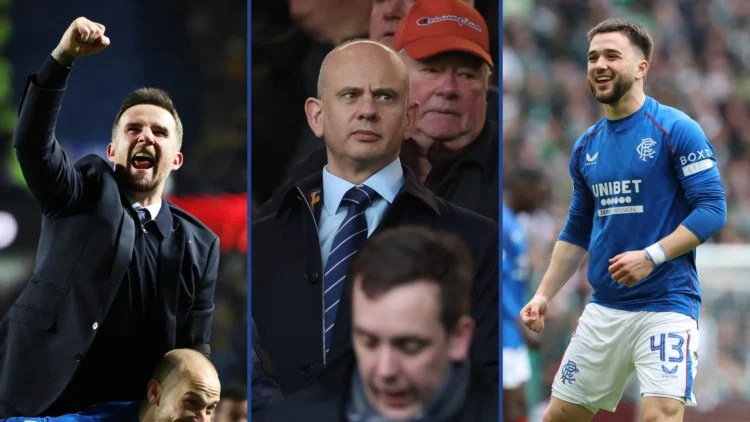
Rangers fans are understandably looking for something to hold onto after yet another season where they’ve fallen short domestically, but the truth is, they remain miles behind Celtic. While they try to spin an imminent US takeover and a Europa League quarter-final run as signs of progress, the harsh reality is that Celtic are once again closing in on a historic achievement—potentially securing a sixth domestic treble in just nine seasons. That kind of sustained dominance isn’t something that can be undone overnight, no matter how much money new investors might throw at Rangers.
Celtic’s Dominance Shows No Signs of Slowing
For all the talk of change at Ibrox, Rangers are still looking for a fifth permanent manager in four years, while Celtic continue to thrive under Brendan Rodgers. The Hoops have built a system of long-term stability, with a clear recruitment strategy, a strong core of players, and an elite mentality that sees them consistently rise to the occasion in big moments.
Rangers fans may point to their victory at Celtic Park as a glimmer of hope, but one win doesn’t change the bigger picture. Over the course of the season, Celtic have been the better, more consistent side—just as they have been for the vast majority of the last decade. Winning one Old Firm derby doesn’t erase the fact that Celtic are marching towards another league title and have already lifted the Premier Sports Cup after once again outclassing their biggest rivals in a final.
The US Takeover Won’t Solve Rangers’ Problems Overnight
The idea that the 49ers Enterprises-led takeover will instantly transform Rangers into a force to be reckoned with is wishful thinking. Yes, investment could help in the long run, but financial backing alone doesn’t guarantee success. Celtic have consistently outperformed Rangers not just because of spending power, but because of smart footballing decisions, from recruitment to managerial appointments.
Rangers have spent significant money in recent years, but most of it has been wasted on poor signings. Players like Cyriel Dessers and Sam Lammers, brought in last summer, have failed to deliver at the level expected of a club trying to compete for major honours. Meanwhile, Celtic continue to find gems like Adam Idah, who has made an immediate impact, and Paulo Bernardo, who is proving to be an excellent long-term investment.
Even with new ownership, Rangers will still need to build a sustainable football operation—something Celtic have perfected over the years. And given that Rangers are still trying to appoint a sporting director after more than a year without one, it’s clear they are playing catch-up behind the scenes.
Rangers’ Managerial Merry-Go-Round Continues
Since Steven Gerrard left, Rangers have been through Giovanni van Bronckhorst, Michael Beale, and now Philippe Clement, and yet, they’ve still only won one major domestic trophy in that time. Now, with the prospect of yet another managerial change looming, they risk further instability.
Compare that to Celtic, who have seamlessly transitioned from Ange Postecoglou to Brendan Rodgers without losing momentum. While Rangers struggle to get things right at the top, Celtic have a clear structure in place that ensures continued success, regardless of who is in the dugout.
Barry Ferguson may have steadied the ship in an interim role, but Rangers need more than just a short-term fix. If they don’t get their next appointment right, they could fall even further behind. Meanwhile, Celtic have the luxury of focusing on fine-tuning their squad rather than overhauling it every year.
The ‘Young Talent’ at Rangers is Still Unproven
Rangers fans are quick to talk up their young squad, but the reality is, most of their prospects are still unproven at the highest level. Players like Clinton Nsiala, Jefte, and Hamza Igamane may have potential, but potential doesn’t win trophies—consistent quality does.
At Celtic, the next generation is already stepping up. Bernardo has established himself as a key midfield player, Adam Idah has been a revelation since arriving in January, and Liam Scales has grown into a rock-solid defender. Even young talents like Rocco Vata are being carefully developed within a winning environment, ensuring that when they do get their chance, they’re ready to contribute.
At Rangers, the emphasis seems to be on talking up young players rather than integrating them into a successful system. Until they prove themselves in big games, there’s no guarantee that any of them will be the difference-makers Rangers need.
Celtic’s European Aspirations Remain High
Rangers’ run in the Europa League is admirable, but ultimately, it won’t make up for their domestic shortcomings. They’ve had memorable European nights before—most notably their 2022 final run—but the reality is, they still haven’t won a major European trophy since 1972.
Celtic, on the other hand, continue to push forward on the European stage. The Hoops have faced tougher opposition in the Champions League this season, but they remain committed to competing at the highest level rather than settling for second-tier European football. Under Brendan Rodgers, there’s a clear ambition to improve on the continental front, something that aligns with the club’s long-term strategy.
Rangers fans can dream of another final run, but history suggests they’ll ultimately fall short. Even if they get past Athletic Bilbao, there are still major hurdles ahead, and their inconsistency this season doesn’t bode well for their chances of going all the way.
Celtic Remain Scotland’s Dominant Force
At the end of the day, Rangers’ attempts to spin their season into something positive can’t hide the reality—Celtic are still the best team in Scotland. The Hoops have the best squad, the best structure, and the best winning mentality. They are on the verge of yet another historic treble, while Rangers continue to search for answers.
For all the noise about takeovers, young players, and European runs, Rangers remain in Celtic’s shadow. Until they prove otherwise on the pitch—consistently and over the course of a season—they will continue to play catch-up while Celtic set the standard for success in Scottish football.