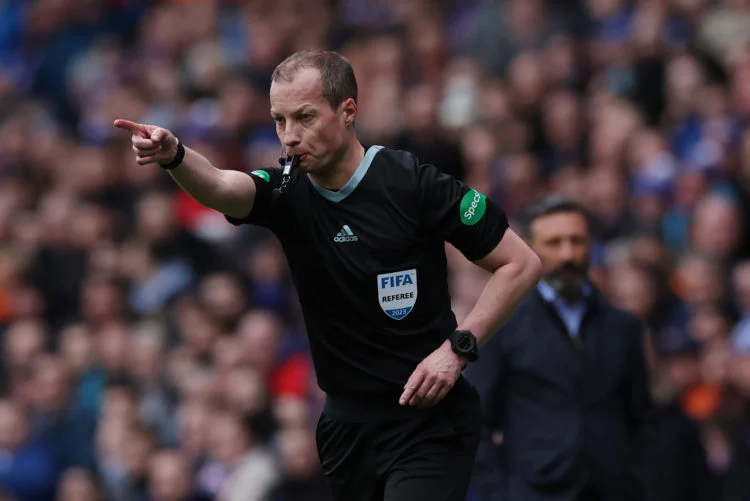
Willie Collum’s recent admission about his infamous penalty decision in the 2010 Glasgow Derby is a rare example of a referee publicly acknowledging a mistake. However, while it’s commendable that he’s finally taken some responsibility for what was a blatant error, his explanation does little to ease the frustration Celtic fans have carried for 14 years. That decision, one of the most controversial in modern derby history, had a major impact on the game and remains a sore point for many supporters who believe that poor officiating cost their team dearly that day.
A Decision That Shaped the Game
The moment in question occurred in a heated Old Firm clash at Celtic Park, a fixture always filled with intensity and high stakes. Rangers’ Kirk Broadfoot hit the deck in the penalty area despite no clear contact from Celtic defender Daniel Majstorovic. To the astonishment of Celtic players, fans, and pundits alike, Collum immediately pointed to the spot. What made the decision even more bizarre was that Collum appeared to have his back turned at the time of the incident, leading many to question how he could have been so certain about awarding a penalty.
This was a pivotal moment in the match. With Rangers already having the momentum, the penalty allowed them to take further control, ultimately winning the game 3-1. The frustration for Celtic supporters wasn’t just about the decision itself—it was about what it represented: another example of questionable officiating in a derby match where the stakes couldn’t have been higher.
Collum’s Explanation Raises More Questions
Collum’s recent comments don’t exactly inspire confidence in his decision-making at the time. While he now acknowledges that awarding the penalty was a mistake, his explanation for how it happened is unconvincing. He insists that he didn’t have his back to the play, despite visual evidence suggesting otherwise, and instead claims that he “caught the latter stage of the decision.”
This raises a key question: if he didn’t see the full incident, why was he so quick to award a penalty? A referee’s job is to be absolutely certain before making a game-changing decision, especially in a match as significant as an Old Firm derby. The fact that he effectively guessed what had happened rather than properly assessing the situation is an alarming admission. This wasn’t a case of a minor misjudgment; it was an error that swung the momentum of a crucial match, one that could have had implications for the league title.
Even more frustratingly, Collum seems to downplay the severity of the mistake. Instead of simply admitting that he got it completely wrong, he suggests that he only saw part of the challenge and that the angle misled him into thinking it was a penalty. However, referees are expected to position themselves correctly to make the right calls—if Collum was out of position, that’s another mistake in itself.
The Broader Issue: Refereeing Standards in Scotland
Collum’s blunder wasn’t just a one-off incident; it was emblematic of the wider issues with Scottish refereeing at the time. Before VAR, there was no way to correct blatant errors like this, meaning referees had no safety net to ensure fairness. While mistakes happen in football, some errors are more costly than others, and when a referee’s decision can alter the course of a match, it rightly comes under intense scrutiny.
Even now, in the era of VAR, Scottish referees have been widely criticized for their inconsistent decision-making. The introduction of technology was supposed to eliminate these kinds of controversies, but instead, it has often added another layer of frustration due to poor implementation and questionable calls. The fact that Collum, who made such a high-profile mistake in 2010, is now in charge of overseeing VAR in the Scottish Premiership does little to reassure fans that standards are improving.
Kirk Broadfoot’s Role in the Controversy
While much of the blame falls on Collum, the actions of Kirk Broadfoot in this incident cannot be ignored. Despite all the evidence showing that there was no clear contact from Majstorovic, Broadfoot went down in the box as if he had been fouled. It was the kind of exaggerated reaction that has plagued football for years, where players try to deceive referees into awarding penalties.
What makes Broadfoot’s actions even more frustrating is his refusal to admit any wrongdoing. At the time, he was adamant that he had been fouled, despite replays showing otherwise. “Of course there was contact—I’m not going to sit here and say I dived,” he insisted. “There was no way I dived. If you look back at it a million times he’s hit me and has knocked me off balance.”
This statement is almost laughable in hindsight. Every angle of the incident showed that Majstorovic made no real contact, yet Broadfoot stuck to his story. Diving has long been a contentious issue in football, and incidents like this highlight why it’s such a problem. When a player exaggerates contact to win a penalty, it puts the referee in a difficult position—although in this case, Collum’s poor positioning and eagerness to make a call only made matters worse.
A Long-Awaited but Meaningless Admission
Celtic fans who were outraged by the decision in 2010 may feel a small sense of vindication now that Collum has admitted his mistake, but in reality, his words change nothing. The result of that match remains the same, and the frustration of watching their team suffer due to a poor refereeing decision is something that won’t be erased by an apology—especially one that comes 14 years too late.
The bigger issue is whether Scottish refereeing has truly improved since then. Collum now holds a position of power as the referee chief at the Scottish FA, meaning he is responsible for ensuring that errors like this don’t happen again. But given the continued controversies surrounding officiating in the Scottish Premiership, there are serious doubts about whether meaningful change has taken place.
If Collum’s experience as a referee has taught him anything, it should be the importance of accountability and getting the big decisions right. His admission of fault in the 2010 derby is a start, but what fans really want to see is consistency and improvement in officiating going forward. VAR was introduced to help eliminate these kinds of errors, yet we continue to see baffling decisions week after week in Scottish football.
Final Thoughts
At the end of the day, Collum’s admission is a case of too little, too late. While it’s always good to see a referee take responsibility for a mistake, it doesn’t undo the impact it had on that game or on Celtic’s season. What’s more important now is ensuring that these kinds of errors don’t continue to plague the Scottish game.
Celtic fans won’t forget that day in 2010, and they won’t forget the frustration of seeing their team suffer due to an official’s incompetence. Collum may have finally admitted he was wrong, but the real question is whether his leadership as referee chief will do anything to prevent similar injustices from happening in the future. Given the track record of Scottish officiating, many will remain skeptical.