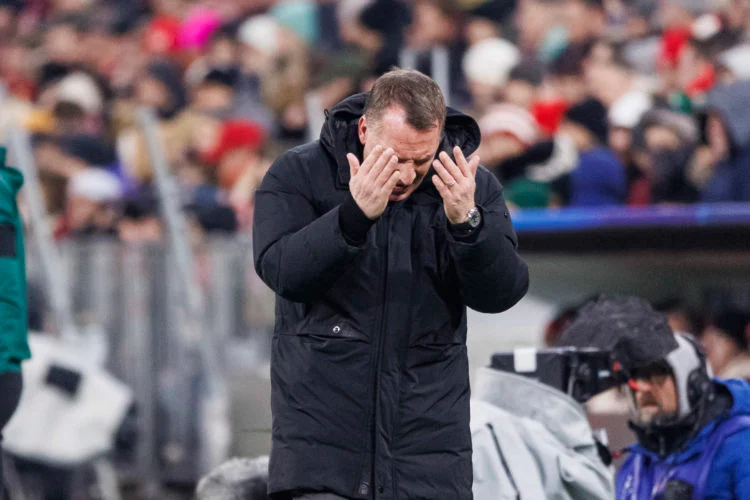
Brendan Rodgers has responded to UEFA’s latest sanction with a calm and composed approach, making it clear that he has no intention of letting it become a distraction. The Celtic boss has been handed a suspended touchline ban following an alleged delay to the second half’s kick-off during the dramatic Champions League clash against Bayern Munich back in February. While the ban is currently suspended and will only be enforced if another breach occurs within the next year, it is another example of UEFA’s increasing focus on managerial and club conduct during European fixtures.
Rodgers addressed the situation in his pre-match press conference ahead of Celtic’s upcoming clash with Hearts, acknowledging that he had only recently learned of the sanction and that he wasn’t particularly concerned about it. He expressed surprise at the ruling, stating that he wasn’t aware that Celtic had done anything different compared to their usual routine when returning for the second half. While European competitions tend to have stricter timekeeping regulations compared to domestic leagues, Rodgers appeared unfazed, suggesting that this was simply a case of UEFA being more stringent in their enforcement rather than Celtic deliberately delaying proceedings.
The incident itself took place in what was one of Celtic’s most emotionally charged matches in recent memory. Going up against German giants Bayern Munich, the Hoops came agonizingly close to securing what would have been a historic result. For much of the game, Celtic held their own against the Bavarian powerhouse, only to suffer heartbreak in the dying moments when Bayern snatched a late winner. It was a crushing defeat, made all the more painful by the fact that Rodgers’ side had fought bravely throughout the match. Now, weeks after that night, the club is still dealing with its aftermath, not just in terms of disappointment but also in the form of UEFA’s disciplinary measures.
While the suspended touchline ban is unlikely to affect Rodgers directly unless further breaches occur, this latest ruling is not an isolated incident. Celtic have been in UEFA’s sights on multiple occasions this season, with various sanctions and fines handed down to the club. The Bayern Munich tie alone resulted in more than one punishment, as the governing body also issued a €9,000 fine for the blocking of public passageways at Celtic Park during the first leg. This was deemed a violation of Article 38 of UEFA’s Safety and Security Regulations, reinforcing the importance the organization places on stadium safety and crowd management.
Beyond the Bayern Munich matches, Celtic supporters have also found themselves at the center of UEFA’s disciplinary actions, particularly regarding the use of pyrotechnics at away games. The club has already faced warnings and fines due to the actions of some traveling fans, with incidents reported at fixtures against Aston Villa and Borussia Dortmund. At one stage, UEFA even threatened an away stadium ban for Celtic supporters, a serious measure that would have prevented them from attending future European away matches. Although such a ban has not yet been enforced, the repeated nature of these incidents suggests that UEFA is keeping a particularly close eye on Celtic’s behavior, both on and off the pitch.
Financial penalties have also become a recurring theme for the Scottish champions this season. While individual fines might not seem significant for a club of Celtic’s stature, the cumulative effect of multiple sanctions is something that the board will no doubt be keeping an eye on. European competition brings significant financial rewards, but repeated fines and potential restrictions on fan attendance could ultimately have a negative impact in the long run. Moreover, if UEFA were to escalate its punishments—such as enforcing a full stadium ban for supporters at an away match—it could significantly affect the atmosphere and support Celtic receive in crucial European games.
Rodgers, however, remains focused on the footballing side of things. His attitude towards the UEFA sanction suggests he views it as little more than an administrative issue rather than a genuine concern. While he acknowledged that the rules in European competition can sometimes be stricter than what clubs are used to in their domestic leagues, he made it clear that this wasn’t something he would be losing sleep over. With an important match against Hearts coming up and a title race to navigate, the Celtic boss is understandably more concerned with what happens on the pitch rather than UEFA’s disciplinary rulings.
This situation also raises a broader question about UEFA’s approach to enforcement and whether its sanctions are proportionate. Some Celtic supporters might feel that the organization is being overly harsh, particularly given the club’s repeated run-ins with European football’s governing body this season. Others, however, might argue that UEFA’s regulations exist for a reason and that clubs need to be more mindful of ensuring compliance. Timekeeping, stadium safety, and fan behavior are all key areas that UEFA has tightened up on in recent years, and Celtic’s multiple infractions suggest there may be a pattern of minor breaches accumulating over time.
For now, the immediate impact on Rodgers and his team is minimal, but the underlying message from UEFA is clear: further disciplinary issues could lead to harsher consequences. If Celtic want to avoid more serious punishments—such as an actual touchline ban for Rodgers or restrictions on fan attendance—they will need to ensure that they are fully compliant with UEFA’s regulations moving forward.
Despite these challenges, Celtic’s primary focus remains on their domestic campaign and their aspirations in Europe. With Rodgers at the helm, the Hoops will continue to push for success on all fronts, and as long as they can stay within the boundaries set by UEFA, they should be able to avoid any further complications. However, with the governing body keeping a watchful eye on the club, any future incidents—no matter how minor—could result in even greater scrutiny and potentially harsher penalties.
What are your thoughts on UEFA’s stance? Do you think their punishments are fair, or is Celtic being treated too harshly?