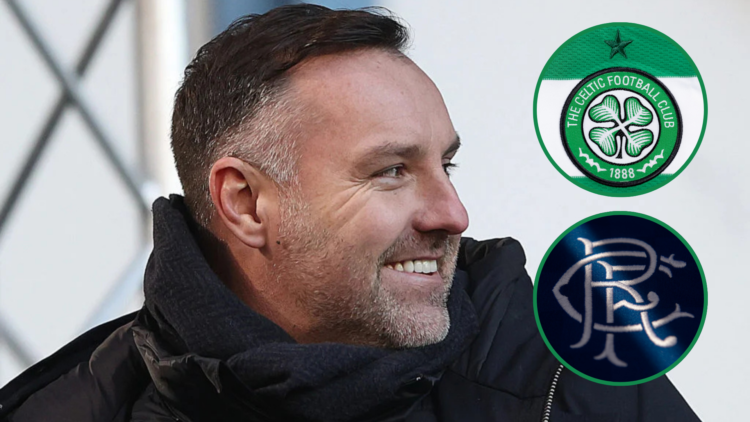
Kris Boyd never fails to entertain, and his latest attempt at rewriting the narrative of the Scottish Premiership season is another classic example of his well-worn tactics. This time, he’s decided to leave out two of Celtic’s standout performers, Nicolas Kuhn and Arne Engels, from his Team of the Year selections, instead opting to shoehorn in Rangers players Vaclav Cerny and Nico Raskin. If this wasn’t such a predictable move, it might actually be surprising. But at this point, Boyd’s relentless need to downplay Celtic’s success while overhyping Rangers has become as much a part of the Scottish football landscape as the league table itself—which, as it stands, shows Celtic comfortably ahead.
It’s difficult to take Boyd’s selections seriously when you actually analyze the season as a whole rather than cherry-picking moments to fit an agenda. Nicolas Kuhn may have experienced a slight dip in form recently, but that shouldn’t overshadow just how impactful he has been throughout the campaign. The German winger has been a revelation for Celtic since his arrival, adding pace, creativity, and an ability to change games with his direct attacking style. His contributions in the early and middle parts of the season were instrumental in ensuring Celtic maintained their dominance at the top of the table.
And yet, Boyd has decided that Vaclav Cerny—a player who has barely had time to settle at Ibrox—is somehow more deserving of a place in the Team of the Year. Cerny has undoubtedly shown flashes of quality, but Boyd’s decision to elevate him over Kuhn reeks of recency bias rather than an objective evaluation of the season. It’s as if Boyd is desperate to convince himself and others that Rangers have found their next superstar, despite the fact that their season, as a whole, has been characterized by inconsistency and underperformance.
Then there’s the case of Arne Engels. The young Belgian has enjoyed a phenomenal debut season at Celtic, registering an impressive 10 goals and 12 assists from midfield—an outstanding return for a player of his age and experience. At just 21, Engels has demonstrated composure, technical ability, and a knack for delivering in crucial moments. He has seamlessly adapted to the demands of Scottish football and looks every bit the kind of player who will only get better in the coming years.
But, of course, Boyd chooses to focus on his £11m price tag rather than the numbers that actually matter. Instead of acknowledging Engels as one of the most productive midfielders in the league, he suggests that the young Belgian isn’t living up to his fee—despite the fact that few players in the league can boast similar attacking returns from midfield. The attempt to frame Engels as some kind of overpriced flop is as transparent as it is laughable. If Engels were at Rangers, Boyd would be leading the charge in declaring him a future star. But because he wears green and white, the goalposts suddenly shift, and his contributions are conveniently ignored.
Meanwhile, Boyd pushes Nico Raskin as a more deserving selection. Now, Raskin is a decent enough player—he’s tidy on the ball, works hard, and does his job in midfield. But has he really had a better season than Engels? Not when you actually compare their impact on their respective teams. Engels has produced more goals, more assists, and has been a consistent performer in a title-winning side. Raskin, on the other hand, has been part of a Rangers midfield that has struggled to assert itself in the big moments, often losing control of games when it matters most.
Boyd’s attempts to justify Kuhn and Engels’ omissions become even more ridiculous when he brings up Kuhn’s wisdom teeth. Yes, you read that correctly—wisdom teeth. In one of the most bizarre and desperate attempts to undermine a player, Boyd suggests that Kuhn’s recent dip in form might be down to dental issues. It’s classic Boyd nonsense, the kind of thing that would be hilarious if it weren’t so embarrassingly forced. Instead of simply admitting that Kuhn has been one of the best wingers in the league this season, Boyd resorts to jokes and jibes that contribute nothing of value to the discussion.
But perhaps the most amusing part of Boyd’s column is his contradictory stance on the title race. On one hand, he is forced to admit that Celtic will be champions again, conceding that there is no scenario in which Rangers can mount a serious challenge this season. “By the time Rangers kick off against Dundee at Dens Park tomorrow night, Brendan Rodgers’ side could be 16 points clear at the top of the table once more,” he acknowledges. And yet, rather than focusing on why Celtic have been so dominant, Boyd continues to push the idea that Rangers are on the verge of something great.
He claims that Rangers have “already proved they know how to raise their game on the big occasion,” despite the fact that they are miles behind Celtic in the standings. He then clings to the idea that Rangers could finish the season with three victories over Celtic, as if that somehow compensates for the fact that they have failed to sustain a proper title challenge. It’s a desperate attempt to salvage some kind of moral victory from a season in which Celtic have once again proven to be the superior team.
Boyd’s final remarks about Rangers’ recruitment issues add another layer of unintentional comedy to his column. He bemoans the fact that Rangers haven’t secured a permanent deal for Cerny, claiming that “it’s typical of the club’s recruitment.” In a rare moment of honesty, he even admits that Celtic have been far better at handling their transfers, highlighting examples such as Odsonne Edouard, Jota, and Paulo Bernardo. It’s a stunning self-own—Boyd essentially acknowledges that Celtic’s approach to squad-building has been more effective, yet he still refuses to give them the full credit they deserve.
At the end of the day, Boyd’s column is just another example of his relentless efforts to downplay Celtic’s achievements while hyping up Rangers at every opportunity. It’s a predictable routine, one that we’ve seen time and time again. No matter how dominant Celtic are, no matter how many times they prove themselves to be the best team in the country, Boyd will always find a way to shift the focus onto Rangers, even when the facts don’t support his argument.
The reality is simple: Celtic are the best team in Scotland, and they are once again on course to win the league title. Kuhn and Engels have been two of the most influential players in that success, and no amount of revisionist history from Boyd can change that. His attempts to rewrite the season are as futile as Rangers’ title challenge—and just like every time before, the truth will win out in the end.