There’s a strange paradox developing at Celtic Park this season. On the surface, the club is still chasing a treble, still perched at the summit of Scottish football, and still showing flashes of brilliance that other Premiership clubs can only envy. And yet, underneath it all, there’s a growing discomfort among fans, pundits, and even within the squad itself. Why? Because everyone can sense it—this Celtic side just isn’t convincing right now.
The 1-0 defeat to St Johnstone is the latest—and perhaps most alarming—example of a trend that’s becoming too familiar under Brendan Rodgers’ second spell in charge. A performance lacking intensity, devoid of creativity, and, worst of all, missing the hunger that defines title-winning teams. What made it worse was the context: this wasn’t a tough away day in Europe or a blood-and-thunder derby. This was bottom-of-the-league St Johnstone at McDiarmid Park, a side Celtic should be brushing aside with minimal fuss. Instead, they left Perth empty-handed and goalless.
And it’s not an isolated incident. Think back to the two recent Glasgow derbies—games where Celtic failed to assert themselves and allowed Rangers to dictate spells. Then there was the flat, uninspired away display at Easter Road against Hibs. The chaotic 3-3 draw with Dundee, where Celtic were in control one moment and all over the place the next. These performances paint a clear picture: Celtic, while still winning more often than not, are becoming inconsistent and increasingly difficult to trust in key moments.
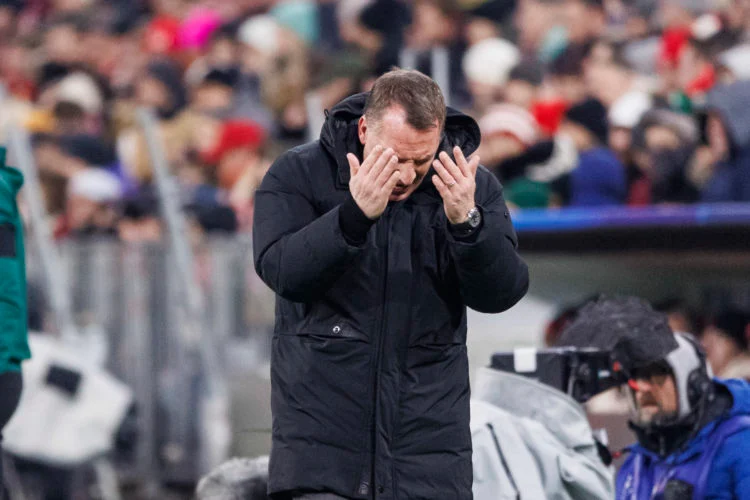
Rodgers’ reaction after the St Johnstone loss was telling. BBC Sportscene presenter Jonathan Sutherland noted he had never heard the Celtic manager be so scathing. And Rodgers has had reason to be disappointed before—he’s not new to this. But this time, the anger felt different. It wasn’t just about tactics or finishing. It was about attitude, mentality, and approach. He publicly called out the squad’s lack of sharpness, their inability to rise to the occasion, and their slow, pedestrian tempo.
That’s not a manager throwing his players under the bus—that’s a man trying to wake a sleeping giant before it costs them everything.
And let’s be honest: Rodgers is right to be worried. Celtic have been sleepwalking through matches in 2025. Their starts have been slow, the ball movement lethargic, and the killer instinct that once terrified opposition teams has gone missing. Where once they pressed aggressively and moved the ball with purpose, now they play as if they’ve got all the time in the world. It’s as if the players believe they’ll win just by turning up.
What’s even more frustrating is that this same team proved they can rise to the occasion. Their Champions League knockout tie against Bayern Munich was a statement of their potential. To take a European giant like Bayern all the way, only to lose to a stoppage-time goal from Alphonso Davies, showed guts, discipline, and belief. For 90 minutes, Celtic were brave, organised, and more than worthy of sharing the stage with one of Europe’s elite.
But domestically? That bravery is gone. The performances feel like they’re being played in third gear. And while you might get away with that in some Premiership fixtures, it only takes one slip-up—like Sunday—to be punished. And let’s not forget, the pressure is very real. Rangers, for all their own inconsistency, are close enough to pounce. Celtic don’t have the luxury of coasting.
So, what’s causing the drop-off?
There’s no easy answer. Some will point to squad fatigue. Players like Matt O’Riley and Reo Hatate have played a lot of football in the last 18 months. Others, like Kuhn and Idah, are still integrating fully or shouldering more responsibility than expected. Injuries have played their part too—Greg Taylor missing spells, key rotations disrupting rhythm. But fatigue alone can’t explain the absence of urgency.
Could it be complacency? Perhaps. When you dominate Scottish football for so long, there’s a danger of slipping into bad habits. Rodgers is a meticulous manager, but he can’t play the game for them. The players have to take personal accountability. They need to show the desire that’s defined so many great Celtic sides of the past.
Then there’s the psychological side. The pressure of chasing a treble, of carrying the weight of expectation every single week, might be taking its toll. And unlike under Ange Postecoglou, where there was a sense of constant forward momentum, Rodgers is battling with a team that already knows what it’s like to win everything. Maybe the edge has dulled.
Tactically, there are questions too. Celtic under Rodgers often play with possession, but the tempo has dropped significantly. The ball is moved side-to-side, lacking the zip that used to stretch defences. Strikers are isolated, wingers aren’t getting enough service, and midfielders are too passive in possession. It’s become easy to defend against.
Even when factoring in pitch conditions—like the dry, bobbly surface at McDiarmid Park—Richard Foster made the right point on Sportscene: both teams play on the same surface. That can’t be used as an excuse. Not for a club with Celtic’s resources and ambitions.
And here’s where Rodgers’ fury makes sense. He’s not angry because they lost one game. He’s angry because this kind of performance is becoming normalised. He’s seen this story before, and he knows how it ends if it’s not addressed quickly. He’s trying to instil a higher standard, because at Celtic, there is no room for mediocrity.
The good news? There’s still time to turn it around. A treble is still on the table. But the margin for error is narrowing, and the response has to come immediately. The players owe it to themselves, the fans, and the badge on their shirts to rediscover that relentless drive.
Celtic should be playing like every game is a cup final. Because in this kind of environment, every game could end up being one.
What do you think needs to happen next? Should Rodgers ring the changes in the lineup or try to stick with his best eleven and demand more?