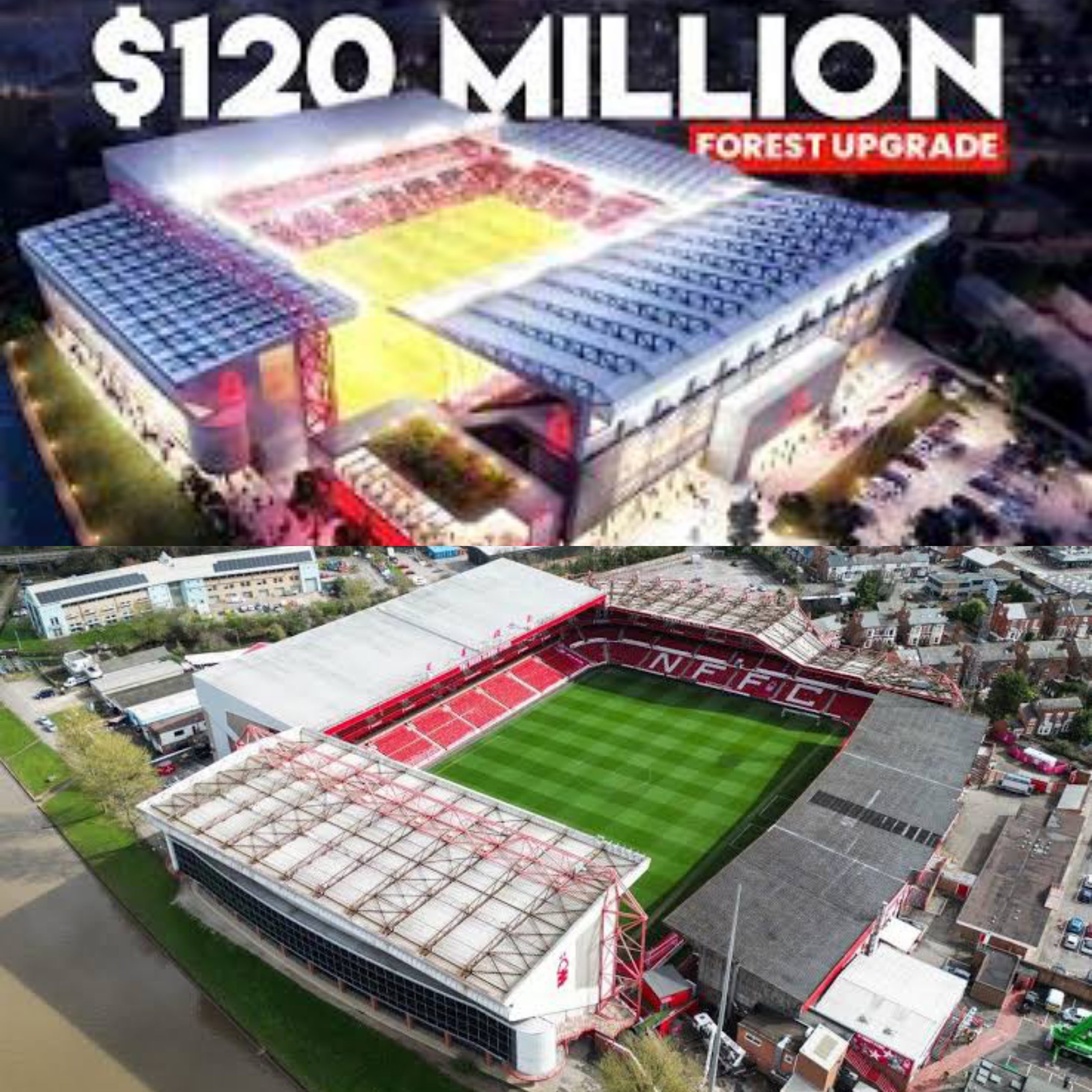
🔴 Rebuilding a Legend: Inside Evangelos Marinakis’ Ambitious £130m Redevelopment of Nottingham Forest’s City Ground
For decades, the City Ground has stood as one of English football’s most iconic stadiums. Nestled along the banks of the River Trent, its red-brick architecture and riverside setting make it instantly recognizable—a bastion of football heritage. But while it holds a revered place in the hearts of Nottingham Forest supporters, the stadium has, for many years, fallen behind in terms of modern infrastructure.
That is finally set to change.
After years of delays, negotiations, and planning revisions, Evangelos Marinakis, Forest’s Greek owner, has secured a monumental breakthrough. Rushcliffe Borough Council has approved the planning permission for the redevelopment of the Peter Taylor Stand—marking the beginning of a new era for the club.
This isn’t just a construction project. It’s a transformation of Forest’s future—a fusion of history, ambition, and community investment that will define Marinakis’ tenure at the club and, potentially, its long-term standing in English football.
⚽ Marinakis’ Vision: A Club Reborn
When Evangelos Marinakis took over Nottingham Forest in 2017, he inherited a sleeping giant. The two-time European champions had spent much of the past two decades languishing outside the top flight. But Marinakis—who also owns Olympiacos in Greece—came in with a bold vision: to restore Forest to the elite and return the club to its rightful place in English football.
On the pitch, promotion to the Premier League in 2022 was a huge milestone. But Marinakis has always maintained that a club’s foundations go deeper than league standings. He believes infrastructure, community engagement, and global identity are just as crucial to long-term success.
Nowhere is that belief more evident than in his commitment to redeveloping the City Ground.
“This is not just a football club. It is a historic institution, part of the soul of Nottingham. We have a responsibility to honor that, and that starts with the stadium,” Marinakis once said in a rare interview.
🏟️ The City Ground: History Meets the Future
Built in 1898, the City Ground is one of the oldest stadiums still in regular use in English football. It was here that Brian Clough built his dynasty, leading Forest to back-to-back European Cup wins in 1979 and 1980. The Peter Taylor Stand, named after Clough’s legendary assistant, has long been a nostalgic centerpiece—but one desperately in need of modernization.
The redevelopment will completely rebuild the Peter Taylor Stand, increasing capacity and providing facilities fit for the modern game. Once completed, the new stand will:
Add approximately 5,000–6,000 seats, taking the stadium’s total capacity to over 35,000.
Include new hospitality suites, improved concourses, and corporate spaces.
Feature enhanced accessibility for disabled fans and families.
Provide cutting-edge media facilities, dressing rooms, and player areas.
Be built to environmentally sustainable standards, including energy-efficient systems and reduced carbon impact.
But for all its forward-looking ambitions, the design retains a respect for the club’s legacy—ensuring that the spirit of the City Ground is not lost in the process of modernization.
💸 The Financial Commitment: £130 Million and Rising
What began as a £94 million project has now ballooned to £130 million, due in part to inflation, design revisions, and delays in planning and logistics. Yet Marinakis remains fully committed.
Rather than taking on excessive debt or seeking external investors, Marinakis is funding much of the project through personal investment—an increasingly rare move in the era of leveraged ownership. It underscores his long-term approach to club-building.
According to a detailed economic impact report, the redevelopment is expected to:
Generate £13 million per year for the local economy.
Create 264 full-time and part-time jobs, during and after construction.
Stimulate tourism, hospitality, and retail activity in the area.
Increase non-matchday revenue through conferences, events, and tours.
This level of economic stimulation played a key role in Rushcliffe Council’s support for the plans. The redevelopment isn’t just about football—it’s about urban regeneration.
🧱 Planning Hurdles: Why Has It Taken So Long?
Though the announcement of planning approval is a landmark moment, the road to this point has been anything but smooth.
Since 2019, the club has faced multiple delays, primarily due to:
Land ownership issues around the Trent Embankment.
Legal negotiations with Nottingham Rowing Club and associated bodies.
Revisions to infrastructure requirements laid out by local authorities.
The need to align planning documents with changes in environmental and transport policy.
One of the most significant obstacles still looming is the Britannia Boathouse, home of Nottingham Rowing Club. Located adjacent to the stadium, the building must be demolished to make room for the expanded stand. However, Forest is required to provide a new, fully operational boathouse before any demolition can occur.
As of the latest reports, a new site for the boathouse has not been finalized, creating a potential bottleneck that could push construction further into 2026.
In addition, Forest must fulfill a series of infrastructure obligations as part of the planning conditions, including:
£1 million contribution to improve local bus services.
£200,000 allocated to cycling infrastructure, particularly around Lady Bay Bridge.
Implementation of traffic control measures and updates to pedestrian safety routes.
These conditions are designed to minimize disruption to local residents and support a sustainable transport network, especially important given the anticipated increase in matchday visitors.
⏳ When Will Construction Begin?
With the planning greenlight secured and financial backing in place, the next steps are now in motion. However, there is no definitive construction date yet, due to outstanding logistical and legal requirements.
Forest’s use of the stadium to host an England men’s international fixture in June 2024 created scheduling challenges, pushing work into the following year. A realistic target for initial ground-breaking may now be late 2025 or early 2026, assuming the boathouse issue is resolved.
Once started, the project is expected to take approximately 18–24 months to complete. The club may adopt a phased approach to allow some construction while maintaining matchday operations, much like the ongoing renovations at Liverpool’s Anfield or Fulham’s Craven Cottage.
🔴 Forest’s Place in the Modern Game
Beyond the bricks and mortar, this project reflects a broader transformation at Nottingham Forest. Under Marinakis, the club has gone from Championship obscurity to a Premier League outfit with serious ambitions. On the pitch, recruitment has been aggressive—sometimes controversial—but always with an eye on consolidation and growth.
The stadium redevelopment provides the infrastructure to match those ambitions. With increased capacity, better corporate facilities, and improved fan experience, Forest will be better placed to compete with the Premier League’s commercial powerhouses.
Moreover, it helps solidify the club’s identity as a community institution. The City Ground is not being abandoned or replaced—it is being reborn. Unlike clubs that have moved to soulless out-of-town arenas, Forest’s decision to stay rooted in its historic home speaks volumes about its commitment to its fans and city.
📣 Fan Reaction and Community Response
The response from supporters has been overwhelmingly positive. While frustrations over delays have been voiced, the clarity provided by this latest approval has reignited excitement.
Fan groups, including the Nottingham Forest Supporters’ Trust, have welcomed the plans, especially the focus on preserving the club’s heritage, improving matchday experience, and contributing to Nottingham’s economic growth.
Local businesses are also poised to benefit. Pubs, restaurants, and shops along the Trent and in West Bridgford are expected to see a surge in trade both during and after the redevelopment.
🏁 Conclusion: A Defining Moment for Club and City
The redevelopment of the Peter Taylor Stand is far more than just a construction project. It is a symbol of Nottingham Forest’s rebirth—a physical representation of ambition, heritage, and progress.
For Evangelos Marinakis, it could prove to be the crown jewel of his ownership, a legacy project that outlives results on the pitch. For fans, it promises a more vibrant, inclusive, and modern experience. And for the city of Nottingham, it offers a valuable economic and cultural investment.
The road ahead is still dotted with challenges, but after years of setbacks, the future of the City Ground is no longer stuck in planning limbo—it is finally, and firmly, under construction in spirit.