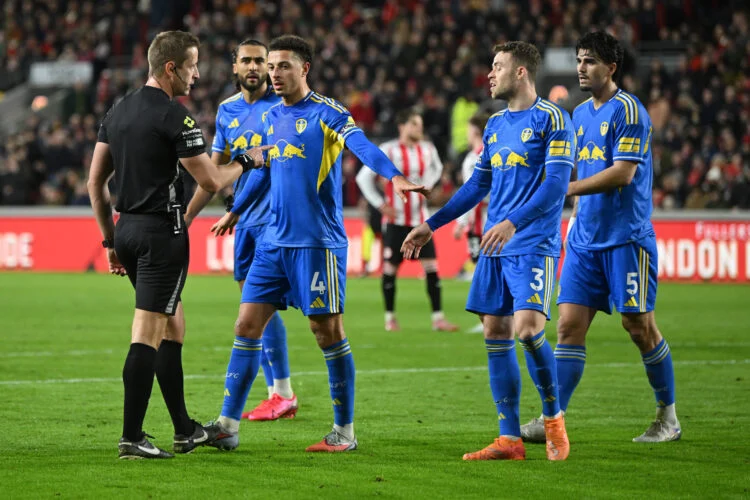
If Dominic Calvert-Lewin had not stepped up and saved Leeds United with a late equalizer, the aftermath of their 1-1 draw at Brentford would have been nothing short of chaotic. The points were snatched away by a clinical finish from the striker, but the controversy surrounding referee John Brooks’ decisions could have overshadowed a defeat — and Leeds fans, as well as manager Daniel Farke, would have been in full meltdown mode, demanding answers.
The atmosphere at the Brentford Community Stadium was already tense, and Brooks’ officiating only added fuel to the fire. The referee’s performance on Sunday evening was a source of immense frustration for Leeds, and even though they managed to escape with a point thanks to Calvert-Lewin’s fifth goal of the season, the referee’s questionable decisions became a hot topic of debate.
Leeds United might have walked away from the game still unbeaten in their last three outings, but Farke’s frustration with Brooks was palpable. It’s rare for Farke to be openly critical of referees, but in this case, his concerns were justified. From strange calls to questionable decisions in key moments of the match, Brooks’ performance had the potential to swing the game in Brentford’s favor — something that Farke certainly did not hold back from addressing post-match.
The First Major Controversy: The Penalty Decision
The most glaring controversy occurred in the first half when Brooks awarded Brentford a penalty after a challenge from Gabriel Gudmundsson. The decision was met with immediate disbelief from Leeds players and supporters alike. On first glance, it looked like a soft decision, with Gudmundsson’s challenge on Brentford’s Yoane Wissa hardly appearing to warrant a penalty. Replays only seemed to confirm that the challenge was minimal at best.
For the Leeds bench, the call seemed inexplicable. In their eyes, the foul was not significant enough to justify a penalty in such a high-stakes encounter. But the drama didn’t end there.
The penalty decision itself might not have been as much of an issue had it not been for the fact that Brentford’s Dango Ouattara was in an offside position when the ball was played into the box. Had the flag gone up earlier, the penalty would have been rendered irrelevant, but instead, the game continued, and the penalty was awarded.
In the end, Leeds were lucky that the offside flag was raised, meaning that the penalty call was nullified — but the fact that it had to be reviewed after the event only served to add further frustration. While it might not have been a clear-cut error, the officiating felt as though Leeds were being treated unjustly, especially considering how much was at stake.
Leeds’ Own Penalty Shout: Denied and Ignored
As the game wore on, Leeds would have a major shout for a penalty of their own — and this one seemed far clearer than the earlier one given to Brentford. In the second half, Nathan Collins of Brentford was guilty of hauling down Calvert-Lewin inside the penalty area as the striker surged into the box. The challenge was blatant — Collins had a firm hold on Calvert-Lewin’s shirt and made no attempt to play the ball. Yet, despite the clear obstruction, Brooks waved play on.
The Leeds players, not to mention the supporters in the stands, were furious. It was textbook obstruction, and with Leeds pressing for a goal, this was a pivotal moment where a penalty could have changed the game in their favor. Former Premier League referee Mark Clattenburg weighed in on the matter, saying that Brooks should have pointed to the spot without hesitation.
Clattenburg, whose reputation as a referee is well-established, made it clear that the challenge on Calvert-Lewin met the criteria for a penalty, adding fuel to the growing debate about Brooks’ inconsistent decision-making on the day. Had Leeds received the penalty, they could have been in control of the match with a crucial lead, but as it stood, the decision to deny them a spot-kick only heightened the sense of injustice.
The Final Insult: Rodon’s Missed Free Kick
Then, just when it seemed that things couldn’t get any stranger, Joe Rodon found himself at the heart of another bizarre moment. With the game nearing its conclusion, the Leeds defender was clattered into from behind as he attempted to clear the ball. It was a clear foul — there was no ambiguity about it. The crowd reacted immediately, anticipating a whistle. But Brooks, once again, chose to play on.
The silence that followed the challenge was deafening. Rodon looked at the referee in disbelief. Was it a foul? Was it not? Leeds players and fans couldn’t fathom why Brooks had ignored what seemed to be a textbook free kick situation. But the story didn’t end there. After the match, Rodon spoke to Radio Leeds and revealed that Brooks had approached him to explain the incident. And the explanation was nothing short of baffling.
“He came and told me it was a free kick,” Rodon recalled. “I think he just wanted to play on — that’s the rule now. But no, he told me at the end that it was a free kick and he was offside. So, yeah, I was a bit confused by that one.”
Rodon’s confusion was understandable. Not only had Brooks admitted the foul, but he also stated that the player who committed the foul was offside. In essence, Rodon had been denied a free kick because the referee chose to “let it go.” This revelation only deepened the frustration for Leeds, who had every right to feel aggrieved by the decisions made in what was a crucial match.
Leeds’ Troubled History with John Brooks
It’s not the first time that Leeds United have found themselves on the receiving end of dubious officiating when John Brooks is the referee. In fact, the club’s record with Brooks is abysmal, and the frustrations felt by fans on Sunday were all too familiar.
Leeds’ most painful memory of Brooks’ refereeing came in the 1-0 play-off final loss to Southampton — a game that still lingers in the minds of many supporters. But it wasn’t just that one game. Under Farke’s reign, Leeds have struggled in every match that Brooks has officiated. The last time Brooks took charge of a Leeds match was in the ill-fated 3-1 loss to Southampton, one of three defeats to the Saints last season. Over nine games officiated by Brooks, Leeds have won just twice. That record — combined with the controversial nature of Sunday’s performance — has led to a growing sense of frustration among fans and players alike.
Calvert-Lewin’s Heroics Save Leeds, for Now
Luckily for Brooks, his blunders were overshadowed by a moment of brilliance from Calvert-Lewin. The striker, who had been Leeds’ main attacking threat throughout the match, met a delicious cross from Willy Gnonto and powered it home to secure the equalizer. It was a much-needed goal for the striker, who has been in fine form this season. Calvert-Lewin’s timely intervention spared the referee from facing even more severe criticism and kept Leeds’ unbeaten run intact.
For Farke, the point — though important — did little to mask the frustration with the officiating. Leeds were still very much in the game and fighting for the win, but the officiating errors prevented them from taking full control of the match. The draw kept Leeds’ momentum alive, but it was a point that felt far from deserved given the controversial decisions made by Brooks.
Looking Ahead: Can Leeds Keep the Run Going?
With Leeds now unbeaten in their last three matches, they will look to build on this momentum. Next up, they will face Crystal Palace at Elland Road, followed by a trip to a Sunderland side that is severely weakened by AFCON call-ups. Leeds, buoyed by their attacking options and the return to form of key players like Calvert-Lewin, will hope to continue their unbeaten run before the new year.
But as the season progresses, the spectre of refereeing errors — especially those involving John Brooks — continues to loom large. Leeds United may have escaped with a draw on Sunday, but their history with Brooks leaves many questioning whether they’ll ever get a fair shake when he’s in charge. For Farke and his players, it’s a matter of hoping the decisions go their way in the next crucial fixtures.
And if Leeds are to push for a top-half finish and ultimately secure survival, they’ll need more than just strong performances on the pitch — they’ll need to navigate the inevitable controversies that surround their matches, particularly when John Brooks is refereeing.