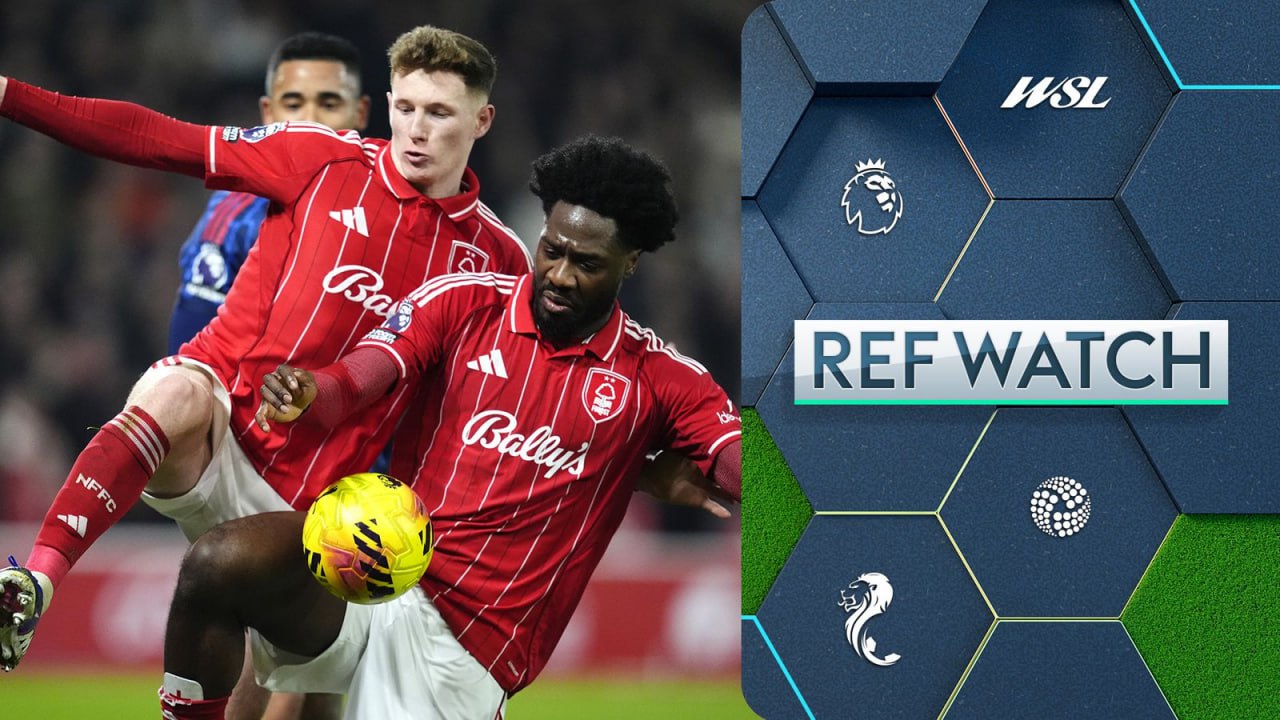
In the high-stakes theater of the Premier League title race, a single second can define a season. For Arsenal, that second occurred in the 80th minute at the City Ground on Saturday, January 17, 2026. As the ball skipped off the turf and made contact with Nottingham Forest defender Ola Aina’s arm, the trajectory of the Gunners’ season seemed to hang in the balance.
The resulting 0-0 draw left Mikel Arteta’s side frustrated, having missed the chance to extend their lead at the top of the table. However, the post-match analysis on Sky Sports’ Ref Watch provided a fascinating look into why the “handball” seen by millions was not a penalty in the eyes of the law.
The City Ground Standoff: Why Arsenal’s Penalty Claims Were Silenced by the Law
The Incident: A Moment of Chaos
The flashpoint arrived late in a tense encounter. With Arsenal probing for a breakthrough against a disciplined Sean Dyche-led Forest side, a cross into the box led to a scramble. Forest full-back Ola Aina, under pressure from Gabriel Jesus, appeared to use his arm to control the ball or at least prevent it from rolling out for a corner.
Mikel Arteta was adamant. “It is a clear penalty,” he fumed in his post-match press conference. “He plays it with his shoulder, but then he brings the arm in to keep the ball inside the pitch. The intention of the player is very clear.”
Despite the frantic appeals from the Arsenal bench and a swift VAR check from Darren England at Stockley Park, referee Michael Oliver’s original decision to wave play on was upheld.
Dermot Gallagher’s Verdict: Proximity and Physics
Former Premier League official Dermot Gallagher, speaking on Ref Watch, provided the technical defense of the decision. For Gallagher, the incident was a textbook example of “ball-to-hand” rather than a deliberate handling offense.
“The key here is the sequence of contact,” Gallagher explained. “The ball strikes Aina’s shoulder first. Under the current 2025/26 interpretations, if the ball deflections off a ‘legal’ part of the body (the shoulder) onto the arm at close range, the threshold for a penalty is significantly higher.”
Gallagher highlighted two main pillars of the officiating logic:
- The Shoulder-to-Arm Deflection: Because the ball ricocheted off Aina’s own body first, the contact with the arm is often deemed accidental unless the arm is in an “unnaturally bigger” position.
- Natural Silhouette: Gallagher argued that Aina’s arm was in a position consistent with a player turning his body. “He isn’t making himself unnaturally bigger to block a shot; he’s trying to shield the ball. His arm is where you’d expect it to be for a player in that physical tussle.”
Jay Bothroyd: The Player’s Perspective
Former striker Jay Bothroyd joined the discussion, offering a view from the pitch that often differs from the rulebook. While fans often scream for “intent,” Bothroyd noted that physics makes certain handballs unavoidable.
“As a player, you cannot move with your arms glued to your sides,” Bothroyd said. “When Aina turns to protect the ball from Jesus, his arm naturally swings out for balance. If you give a penalty for that, you’re essentially telling defenders they can’t use their bodies to shield the ball.”
Bothroyd agreed with the officials, suggesting that the “clear and obvious” threshold for VAR to overturn Michael Oliver was nowhere near being met. “It’s a messy incident, but it’s not a foul. Arsenal’s frustration shouldn’t be with the ref; it should be with their finishing.”
The Sean Dyche Factor: “Cancel Football”
Never one to shy away from a blunt assessment, Nottingham Forest manager Sean Dyche offered a staunch defense of his player. Dyche’s comments touched on a growing sentiment among managers that the handball rule has become too sensitive.
“If those start getting given, we might as well cancel football,” Dyche remarked. He pointed out that Forest had their own shouts for a penalty earlier in the game when Callum Hudson-Odoi was brought down. “We’ve got to be careful. You can’t just give a penalty every time the ball touches a bit of skin in the box.”
Tactical Fallout: A Blunt Arsenal
While the handball dominated the headlines, the underlying “glaring issue” for Arsenal was their inability to break down the Forest “low block.” Despite dominating 68% of possession and firing 18 shots, only two found the target.
The draw at the City Ground meant Arsenal failed to fully capitalize on Manchester City’s defeat to Manchester United earlier that weekend. While they remain seven points clear, the “what ifs” regarding the Aina incident will likely haunt the Emirates Stadium if the gap narrows in the coming weeks.
The Current Interpretation: Law 12 and the 2026 Standard
The 2025/26 Premier League season has seen a refined focus on “justifiable movement.” The PGMOL (Professional Game Match Officials Limited) issued guidance stating that “touching another body part before contact with the arm does not automatically mean it’s not a penalty, but a very clear deflection… should carry greater weight.”
In Aina’s case, the deflection off the shoulder was the saving grace. Because the ball changed trajectory significantly off a legal body part before hitting the arm, the VAR deemed the arm’s position to be a consequence of the player’s natural movement in the moment.
Conclusion: A Lesson in Perspective
The Ref Watch analysis confirms a hard truth for Arsenal fans: the law was applied correctly, even if it felt like an injustice in the heat of a title race. Football is a game of margins, and on this occasion, the margin was the few inches between Ola Aina’s shoulder and his bicep.
Arsenal leave the East Midlands with a point, a clean sheet, and a sense of grievance. However, as Dermot Gallagher and Jay Bothroyd concluded, the “handball” was a symptom of a frantic game, not a failure of officiating. The title race continues, but for one afternoon in Nottingham, the rulebook was the ultimate winner.