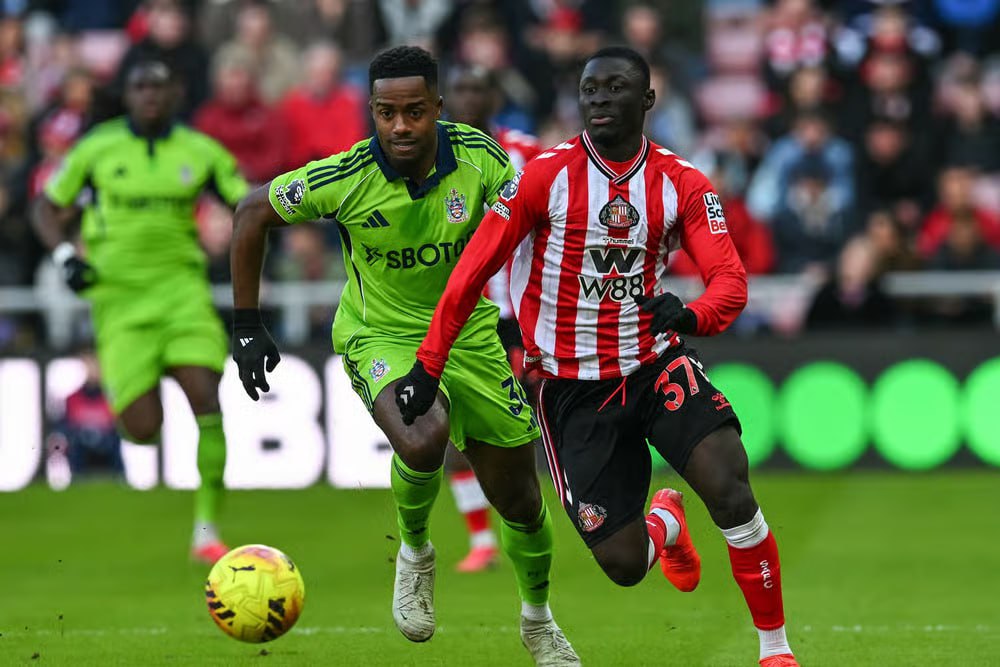
Régis Le Bris has admitted that set pieces have become a growing concern for Sunderland in recent weeks, revealing the club has been working intensively behind the scenes to address the issue ahead of daunting fixtures against AFC Bournemouth and Leeds United.
After a promising start to life back in the Premier League, the Black Cats are enduring their toughest spell of the campaign. Three consecutive league defeats have exposed vulnerabilities — particularly in both penalty areas — with set pieces emerging as a decisive factor.
For a side that built early-season success on organisation and discipline, the recent slippage has been stark.
From Strength to Weakness
Set pieces were once one of Sunderland’s defining weapons.
Anticipating the physical demands of the top flight, the club appointed specialist coach James Brayne and recruited players capable of making an impact in both boxes. The planning paid off during an impressive unbeaten run at the Stadium of Light.
But opponents have adapted.
Liverpool’s winner recently came from a corner. Raul Jimenez opened the scoring for Fulham in similar fashion last weekend. What was once a platform for stability has instead become a source of vulnerability.
Le Bris acknowledged that the issue is not rooted in a single flaw but rather a combination of factors.
“Probably the opponent,” he explained. “They analyse our set-ups and try to find the best way to threaten us.”
The Frenchman pointed to the targeted marking of Dan Ballard as an example. The centre-back, previously a dominant presence, has increasingly been isolated by opposition routines designed to limit his influence.
Evolution Required, Not Panic
Rather than framing the situation as a crisis, Le Bris described it as a natural stage in the team’s development.
“When you reach a certain level and it’s not enough, you have to work harder to reach the next level,” he said.
There are technical details to address — delivery quality against Fulham was singled out — but the broader emphasis is on evolution. Premier League opponents now possess detailed scouting reports, and predictability can quickly become a liability.
Sunderland’s coaching staff have therefore focused on:
- Varying defensive marking structures
- Improving attacking delivery and movement
- Increasing unpredictability in set-up design
In elite competition, marginal gains determine outcomes. Sunderland are learning that lesson in real time.
Context Matters: A Young Squad in a Brutal League
Le Bris also urged perspective.
Sunderland are newly promoted. Their squad remains one of the youngest in the division. Injuries and suspensions have further complicated matters during this recent downturn.
“We are going through a difficult run, which is not comfortable,” he admitted. “But it’s part of the process.”
There is no attempt to disguise disappointment. The head coach is clear that results matter. However, he views this challenging period as formative rather than destructive.
“Tough phases are often when you learn more,” he said. “You need to stick to your identity, stay united, stay calm and work more.”
The message is one of resilience — a refusal to abandon principles when confidence wavers.
Bournemouth and Leeds: A Defining Week
Trips to Bournemouth and Leeds represent significant tests.
Both opponents combine physicality with technical quality and will not hesitate to exploit set-piece weaknesses if given the opportunity. Sunderland’s response — tactically and psychologically — will be telling.
The objective is not simply to stop conceding from dead balls. It is to re-establish control, regain composure, and restore belief.
Le Bris’ long-term project at Sunderland is built on progression rather than instant gratification. The current slump, he insists, does not negate the broader trajectory.
“It doesn’t mean we are not progressing,” he said. “But it’s tough, and you have to accept that.”
For Sunderland, the next step in that progression begins with rediscovering solidity in the areas that once defined them.