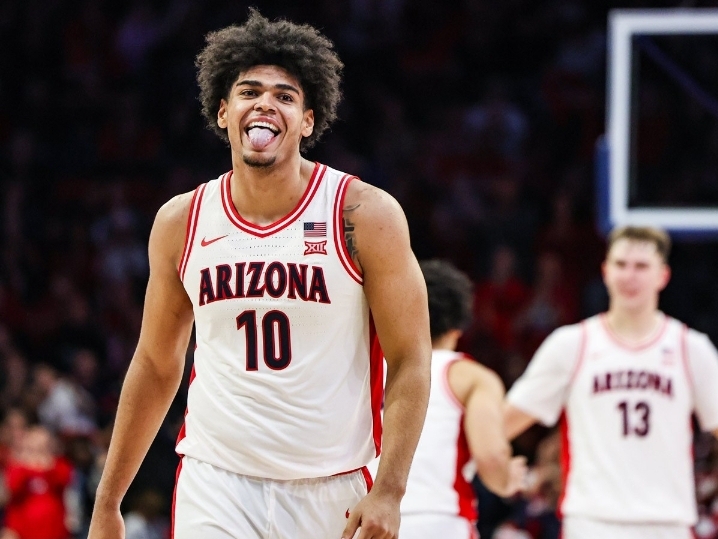
As the Arizona Wildcats celebrate their Big 12 Tournament championship — a gritty 79-74 win over Houston on March 14, 2026, at T-Mobile Center — one freshman forward has emerged as a standout not just for college success, but for NBA translation. Koa Peat, the 6’8″, 235-pound Arizona product, is carving out a reputation as a versatile, physically dominant forward who could slide into the mid-to-late first round. For a Toronto Raptors team built on length, switchable defense, and player development, Peat represents one of the most natural fits available.
Peat’s freshman numbers tell the story of steady production on a championship-caliber team: 13.6 points, 5.3 rebounds, and 2.7 assists per game on 53.7% shooting from the field. He’s shown the ability to dominate inside, stretch the floor (albeit at 31.6% from three so far), and make plays for others. Recent outbursts — like a 25-point, 80% shooting performance against Colorado — highlight the scoring bursts that NBA scouts love. With Arizona rolling into March Madness on a hot streak, Peat’s stock is only climbing.
A Seamless Match for Toronto’s Culture of Versatility and Effort
The Raptors have long prioritized two-way forwards who can guard multiple positions and contribute without demanding the ball. Think Scottie Barnes’ positional flexibility or the kind of physical, high-motor wings that thrive in their system. Peat checks every box. At 6’8″ with a strong, broad frame, he brings the size to bang in the paint while possessing the lateral quickness to switch onto guards and wings.
Pair him alongside Barnes and Brandon Ingram, and Toronto suddenly gains another piece that can slide between the 3, 4, and even small-ball 5 spots. Peat’s defensive instincts — help-side rotations, physical resistance around the rim, and the ability to contest without fouling — align perfectly with the Raptors’ identity under their current coaching staff. He doesn’t need to be the star; he just needs to fit, and few prospects in this range offer that immediate defensive reliability.
Offensive Potential Still Unlocked
Peat isn’t a finished product offensively, and that’s actually part of the appeal. He excels as an interior finisher and mid-range scorer, using his strength to bully mismatches and his budding playmaking to find open teammates. The three-point shot remains inconsistent, but Toronto has a proven track record of turning raw shooters into reliable threats (see past development successes). If Peat adds even average range from deep, he becomes a complete offensive forward capable of spacing the floor next to Toronto’s creators.
His flashes of creation — attacking closeouts, making skip passes, and operating in short-roll situations — suggest he can grow into a secondary playmaker. In a Raptors offense that values movement and unselfish play, Peat’s skill set won’t require heavy usage to be effective from day one.
Realistic Draft Range and Immediate Value
Current 2026 mock drafts project Peat anywhere from the late lottery to the mid-20s. With elite talents like AJ Dybantsa, Darryn Peterson, and Cameron Boozer dominating the top of the board, Toronto (projected around pick 15-20 depending on the rest of the season) is unlikely to reach the absolute cream of the crop. That makes Peat an ideal target: high floor, even higher ceiling, and realistic to acquire without trading up aggressively.
Unlike boom-or-bust projects, Peat offers immediate rotation minutes as a versatile defender and scorer while still possessing the tools to develop into a starter. For a Raptors squad looking to build sustainably around their young core, that combination of present contribution and future upside is gold.
Toronto’s Development Machine Is Built for Players Like This
The Raptors’ greatest asset might be their player-development staff. Prospects who arrive with physical tools, defensive instincts, and offensive flashes routinely take massive leaps in Toronto. Peat fits that profile exactly — he doesn’t need to be NBA-ready on opening night. Instead, he brings a solid foundation that coaches can refine over time: polishing his perimeter shot, tightening his decision-making, and maximizing his athleticism in structured sets.
Final Verdict: A Low-Risk, High-Reward Addition
Koa Peat may not headline highlight reels the way the top prospects do, but he embodies exactly what the Toronto Raptors have prioritized for years: size, versatility, defensive toughness, and long-term growth potential. In a draft class loaded at the top but thin in reliable two-way forwards, Peat stands out as one of the smartest, most realistic selections for a team ready to take the next step.
If Toronto lands in the mid-first round and Peat is still on the board, passing on him could be a mistake they regret for years. The Wildcats’ Big 12 champions have already proven Peat can win at a high level. Now it’s time for the Raptors to see if he can do the same in the NBA.
Peat’s journey is just beginning — and Toronto could be the perfect next chapter.