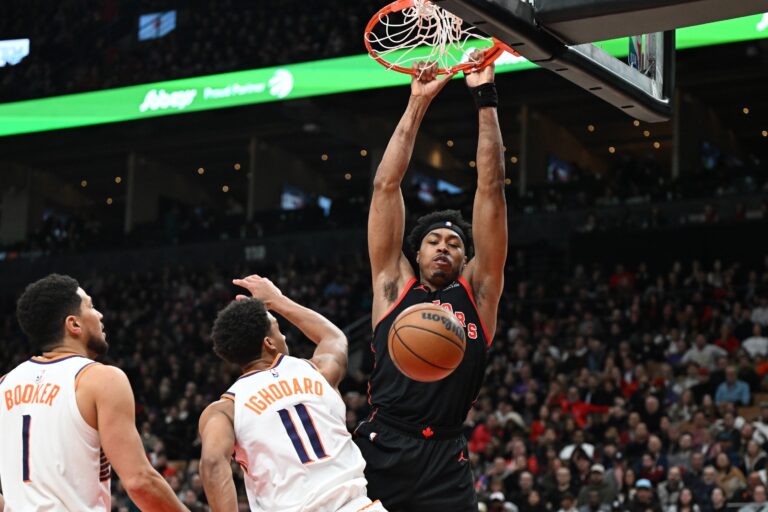
As of mid-March 2026, the Toronto Raptors sit at 37-29, holding the 7th seed in the Eastern Conference. They are just one game behind the 6th-place Miami Heat (38-29) and within striking distance of a direct playoff berth. A few months ago, the team looked like a lock for the top tier, briefly holding the 3rd seed in January with confident, balanced basketball. Now, after a skid and increased competition in the East, the margin for error is razor-thin. With roughly two weeks left in the regular season, the question looms: Can Toronto climb back into the top six and avoid the high-stakes play-in tournament?
A Promising Start That Faded
Early in the 2025-26 season, the Raptors justified preseason optimism. The roster blended youth and veteran additions effectively. Scottie Barnes emerged as the clear centerpiece, delivering all-around excellence. Brandon Ingram, healthy after missing significant time the prior year, provided elite scoring and creation. Immanuel Quickley anchored the backcourt with sharp playmaking and shooting.
Toronto’s offense flowed with ball movement and rim attacks, while the defense showed discipline and versatility. Wins piled up consistently, and the team sat comfortably in the upper half of the East. Barnes’ growth into a franchise leader—pairing scoring, rebounding, facilitating, and multi-positional defense—gave the group stability that many analysts praised.
What Caused the Slide?
The drop from 3rd to 7th wasn’t sudden but stemmed from a combination of factors:
- Heightened Eastern Conference parity — Teams around Toronto (including the Heat, Hawks, and 76ers) heated up, making every loss costly in the standings.
- Injuries and rotation disruptions — Key absences forced adjustments, hurting chemistry at times.
- Brutal schedule — Tough road trips and matchups against top contenders tested the roster’s depth and consistency.
Despite remaining competitive (with a solid +1.5 to +1.7 point differential and strong conference record around 27-16), Toronto no longer controls its destiny. Recent results, like the March 13, 2026, 122-115 home win over the Phoenix Suns (where Ingram dropped 36 points and Barnes added 14 with defensive highlights, including a block on Jalen Green), show flashes of their earlier form.
Why Avoiding the Play-In Is Crucial
The NBA play-in tournament (set for April 14-17, 2026) adds intense pressure for 7th-10th place teams. The 7th seed hosts the 8th in a win-or-go-to-another-game scenario, while 9th hosts 10th (loser eliminated). One off night can end a season prematurely. Top-six teams earn direct entry, plus valuable rest and home-court advantages in the first round.
For a young, still-building Raptors core, skipping the play-in would provide stability, experience, and momentum heading into the postseason. It’s a meaningful edge in a conference where seeds 1-6 (currently led by Detroit, Boston, New York, Cleveland, Orlando/Miami) look formidable.
Scottie Barnes Must Lead the Charge
Barnes remains Toronto’s engine. Through 64+ games, he’s averaging roughly 18.7-19.0 points, 7.8-7.9 rebounds, 5.3-5.4 assists, shooting nearly 50% from the field. His versatility shines on both ends: creating offense, crashing boards, and guarding multiple positions. When Barnes plays with aggression and sets the tone, the Raptors elevate. In the final stretch, his leadership—especially in close games and against direct competitors—will be decisive.
Depth and Role Players as the X-Factor
Beyond the stars, bench and supporting contributions will decide outcomes. Ingram’s scoring punch (around 21+ PPG in recent stretches) pairs well with Quickley’s playmaking (17.3 PPG, 6.0 APG). Veterans and young pieces like Jakob Poeltl, RJ Barrett, and emerging bench options provide energy, defense, rebounding, and shooting.
Depth helps weather fatigue and minor injuries in the grind of late-season games. If role players continue stepping up—as seen in recent wins with secondary scoring and hustle—the Raptors can string together the consistency needed to climb.
The Remaining Schedule and Realistic Outlook
Toronto’s path includes key games against Eastern rivals and a mix of winnable matchups. Head-to-heads against teams in the 6-10 range carry massive weight. A 4-6 or better record in the final stretch could easily flip them into 6th (or higher), as the gap to Miami and others is only 1-2 games in the loss column.
Analysts project the Raptors finishing around 46-48 wins in optimistic scenarios, which has historically been enough for a top-six seed in this competitive East. They’ve already proven they can beat strong teams; replicating that focus without extended losing streaks is the challenge.
A Window of Opportunity Remains
The Raptors are not locked into the play-in yet. At 37-29 with time left, a short winning streak—fueled by Barnes’ all-around dominance, Ingram’s scoring, Quickley’s facilitation, and collective depth—could restore their earlier momentum.
Avoiding the play-in won’t be easy amid East parity and a tough slate, but it’s achievable if the team regains its rhythm, stays healthy, and executes down the stretch. For a franchise building toward sustained contention, securing a direct playoff spot would mark real progress.
The final weeks will tell the story. For now, the door is still open.
(Featured image concept: Scottie Barnes in action, building on recent Raptors-Suns photography. Article draws from current 2025-26 standings, player performances, and season context as of March 2026.)
Tags: Scottie Barnes, Brandon Ingram, Immanuel Quickley, Toronto Raptors, NBA Play-In, Eastern Conference Standings