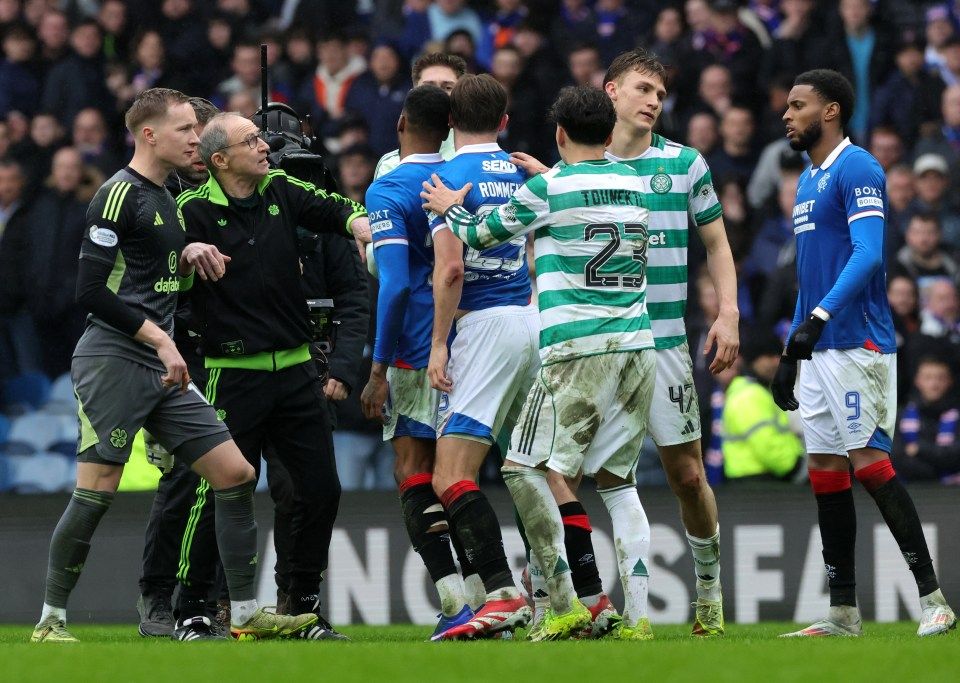
The fallout from Sunday’s dramatic Old Firm encounter at Ibrox continues to rumble on, with former Premier League referee Chris Foy firmly rejecting Rangers’ complaints over the late penalty that allowed Celtic to snatch a 2-2 draw.
In a pulsating contest that saw both Glasgow giants desperate for three points to keep pace with leaders Heart of Midlothian F.C., controversy ultimately overshadowed the football. Rangers raced into a two-goal lead through a stunning first-half brace from Youssef Chermiti, including a spectacular bicycle kick that lit up Ibrox.
But Celtic roared back after the break. Kieran Tierney halved the deficit before late VAR drama took centre stage, when a penalty was awarded against Rangers defender Dujon Sterling for handball. Reo Hatate eventually converted at the third attempt — after Jack Butland had saved both the initial effort and rebound — to secure a share of the spoils.
The result leaves Rangers six points adrift in second place and both clubs playing catch-up in a tense Scottish Premiership title race.
The incident that changed everything
The defining moment arrived when Celtic’s Daizen Maeda rose to meet a cross, directing a powerful header goalwards. Sterling, attempting to challenge, jumped with his arm raised. After a VAR review, the referee was advised to consult the pitchside monitor and subsequently awarded a penalty for handball, judging that Sterling’s arm was in an unnatural position.
For Rangers supporters and club icon Ally McCoist, the call felt harsh.
Speaking on talkSPORT, McCoist argued that while he understood why the decision was given under modern interpretations, he believed Sterling’s arm was in a natural jumping motion.
“I think it’s extremely harsh,” McCoist said. “His hand, for me, is in a natural position. The forward heads the ball off Sterling’s hand — and he gives a penalty. Is that the correct decision?”
Foy: “Arm clearly away from the body”
Chris Foy, however, was unequivocal in his assessment.
Having reviewed the footage multiple times, the former referee admitted initial uncertainty but concluded the VAR intervention was justified.
“When I looked at it again, the arm is clearly away from the body,” Foy explained. “I wasn’t surprised when the referee went over to the monitor and turned the decision over and actually gave a penalty kick.”
The debate quickly became philosophical — not about whether the arm was away from the body, but whether such positioning is natural in the act of jumping.
McCoist insisted footballers cannot leap without using their arms for balance. “What we’re asking players to do now is put their arms in an unnatural position and keep them at their side. You can’t do that.”
Foy countered by questioning why Sterling’s arm was so far from his body during the challenge, implying that modern law interpretations prioritise the outcome — blocking a goal-bound effort — over intent.
The wider VAR debate
The decision has reignited familiar discussions around consistency and interpretation in handball rulings.
Under current IFAB guidelines, a handball offence can be given if a player makes their body “unnaturally bigger” by positioning their arm away from the torso, even if there is no deliberate movement toward the ball.
In this case, officials determined Sterling’s arm increased his silhouette and blocked a potentially goal-bound header.
For Rangers, it was a cruel blow — particularly given the context of the match. Having dominated the first half and looked in control, they were undone not by open play brilliance but by a split-second judgement call.
Managers tread carefully
Rangers boss Danny Röhl avoided outright condemnation when questioned post-match.
“Maybe, maybe not,” he said when asked if the penalty was correct. “It is not really my part. The important thing is that every week you have good decision-making — and today and last week were against us — but this is football.”
His measured tone reflected the delicate nature of officiating criticism in the VAR era. While frustration was evident, Röhl stopped short of direct confrontation.
A costly moment in the title race
The draw carries significant implications.
Hearts’ position at the summit now looks stronger, while Rangers’ inability to protect a two-goal lead raises uncomfortable questions. Celtic, meanwhile, demonstrated resilience but will also recognise the margin for error remains slim.
For Rangers fans, the lingering feeling is one of opportunity lost. Two Chermiti goals had put them in command. Defensive concentration, however, faltered after the interval, and the late penalty drama compounded their misery.
Was it the right call?
From a technical standpoint, Foy’s backing of the decision aligns with modern officiating trends. Arms extended away from the body, particularly when preventing a clear attempt on goal, are increasingly penalised.
Yet McCoist’s argument resonates with many former players: footballers cannot realistically jump without natural arm movement. The grey area lies in defining “natural.”
In a fixture as emotionally charged as the Old Firm derby, such marginal interpretations carry enormous weight.
What is undeniable is that the penalty altered the course of the title race narrative. Whether viewed as correct enforcement of the laws or harsh application of them, it ensured Rangers and Celtic were forced to share the spoils — leaving Hearts as the weekend’s biggest winners.
And as debates rage on airwaves and in pubs across Glasgow, one truth remains: in modern football, the margin between triumph and frustration often rests on the width of an outstretched arm.