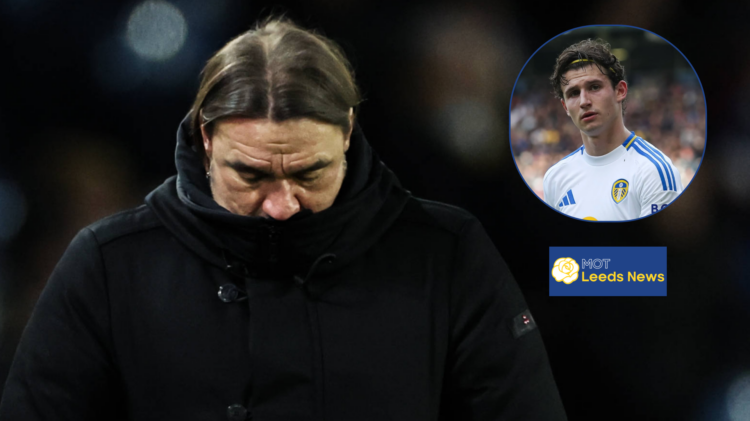
Daniel Farke has made what many are calling a high-risk, potentially season-defining decision ahead of Leeds United’s pivotal clash with Middlesbrough on April 8. With the race for automatic promotion to the Premier League entering its final and most intense phase, Farke’s call to start Brendan Aaronson over Wilfried Gnonto has raised serious questions among fans and pundits alike. For a manager under increasing scrutiny, it’s the kind of bold move that could either reassert his authority and vision—or be the final straw in a disappointing late-season collapse.
Leeds United’s recent slump couldn’t have come at a worse time. The Whites have won just one of their last six league matches, and that faltering form has seen them slip from a strong position in the automatic promotion places to third—outside the top two and now chasing rather than leading. In a league as competitive as the Championship, momentum is everything, and right now Leeds appear to be losing theirs at a critical moment. Middlesbrough away is always a tough fixture, but it now takes on even greater significance: it is a potential turning point, one way or another.
That context makes Farke’s decision to start Aaronson even more controversial. The American attacking midfielder has shown flashes of quality during his time in Yorkshire, but he’s also been consistently inconsistent. His ability to influence games has waned, and in recent weeks, his performances have drawn criticism for a lack of end product, decision-making, and physicality in high-pressure encounters. Aaronson was dropped for the previous match against Luton Town—a game Leeds could only draw against relegation-threatened opposition—and bringing him back for such a massive tie, at the expense of Wilfried Gnonto, is a real statement.
Gnonto, despite being young, has often been one of Leeds’ most direct and dangerous attacking weapons. His pace, dribbling, and willingness to take on defenders provide a dimension to the attack that few others in the squad can replicate. Not only has he delivered in key moments throughout the season, but his style of play suits the kind of aggressive, on-the-front-foot approach needed in crunch away games. The fact that Farke opted to leave him out of the starting lineup suggests either a tactical shift or a gamble based on training-ground form—either way, it is a decision that has the potential to backfire.
Adding to the tension is the enforced change in defence, with Pascal Struijk ruled out after sustaining an injury against Luton. His absence leaves a hole at the back, and Ilia Gruev has been tasked with stepping in. While Gruev has shown glimpses of his ability since arriving at Elland Road, throwing him into such a high-stakes match could expose vulnerabilities, especially given Middlesbrough’s ability to press high and exploit any uncertainty in central areas.
Leeds’ away form this season only magnifies these concerns. Of their 20 away matches so far, they’ve dropped points in 12 and managed just eight wins—a record that simply isn’t good enough for a team aiming for automatic promotion. With three more road games left—against Middlesbrough, Oxford United, and Plymouth Argyle—Farke needs to find a formula that works away from home. These fixtures could make or break the season, and there’s no margin for error. Any dropped points now are likely to be punished by rivals Sheffield United and Burnley, who have both found more consistency in the season’s final stretch.
All of this places enormous pressure on Farke. He was brought in with a clear mandate: take Leeds United back to the Premier League. The board showed faith in him after last season’s heartbreak, backing him in the transfer market and allowing him to build a squad suited to his philosophy. For large parts of the season, it looked like that faith would be repaid. But now, with the team stumbling at the worst possible time, questions are being asked. If Leeds fail to secure automatic promotion and are forced to navigate the notoriously difficult play-offs—where anything can happen—the fallout could be significant.
It wouldn’t be the first time a manager has paid the price for late-season failure. Expectations at Leeds are high, and with the club still reeling from their Premier League relegation and financial pressures mounting, missing out on promotion again would be more than just a disappointment—it would be a setback with serious long-term consequences. Farke’s decision to trust Aaronson over Gnonto, particularly if the result goes against Leeds, will be dissected in detail. Did he overthink it? Was he trying too hard to shake things up when consistency and experience were needed?
If Aaronson delivers, Farke will be hailed for his courage and belief in the squad’s depth. But if he falters—as he has in recent outings—and Gnonto remains benched while Leeds struggle to find a breakthrough, Farke’s judgment will be called into question. And if this game proves to be another missed opportunity, it might not just be Leeds’ automatic promotion hopes that take a hit—Farke’s own position could come under serious threat.
At this stage of the season, with promotion within touching distance yet slipping further away by the week, every decision is amplified. The stakes are enormous, and Farke’s selections for the Middlesbrough clash may go down as either the move that reignited Leeds’ charge to the Premier League—or the moment where it all began to unravel.
Would you like this turned into an editorial-style piece or formatted for publication?