Emmanuel Fernandez and the VAR Drama That Divided Scotland
The granite city of Aberdeen has long been a place where footballing dreams go to be tested against the cold winds of the North Sea. But on a biting Saturday afternoon in January 2026, the temperature at Pittodrie didn’t come from the weather—it came from the white-hot friction of a VAR monitor.
At the center of the storm stood Emmanuel Fernandez, the Rangers defender who, for a fleeting moment, thought he had etched his name into the folklore of one of Scottish football’s most bitter rivalries. Instead, he became the protagonist of a forensic autopsy performed by the “Jury” of pundits, referees, and fans that will be debated in the pubs of Glasgow and the North East for years to come.
The Moment: Gravity vs. The Law
The 28th minute felt like a collision of eras. James Tavernier, the evergreen Rangers captain, stood over a free-kick with the practiced air of a master craftsman. He whipped a delivery into the “corridor of uncertainty”—that panicked space between the penalty spot and the six-yard box.
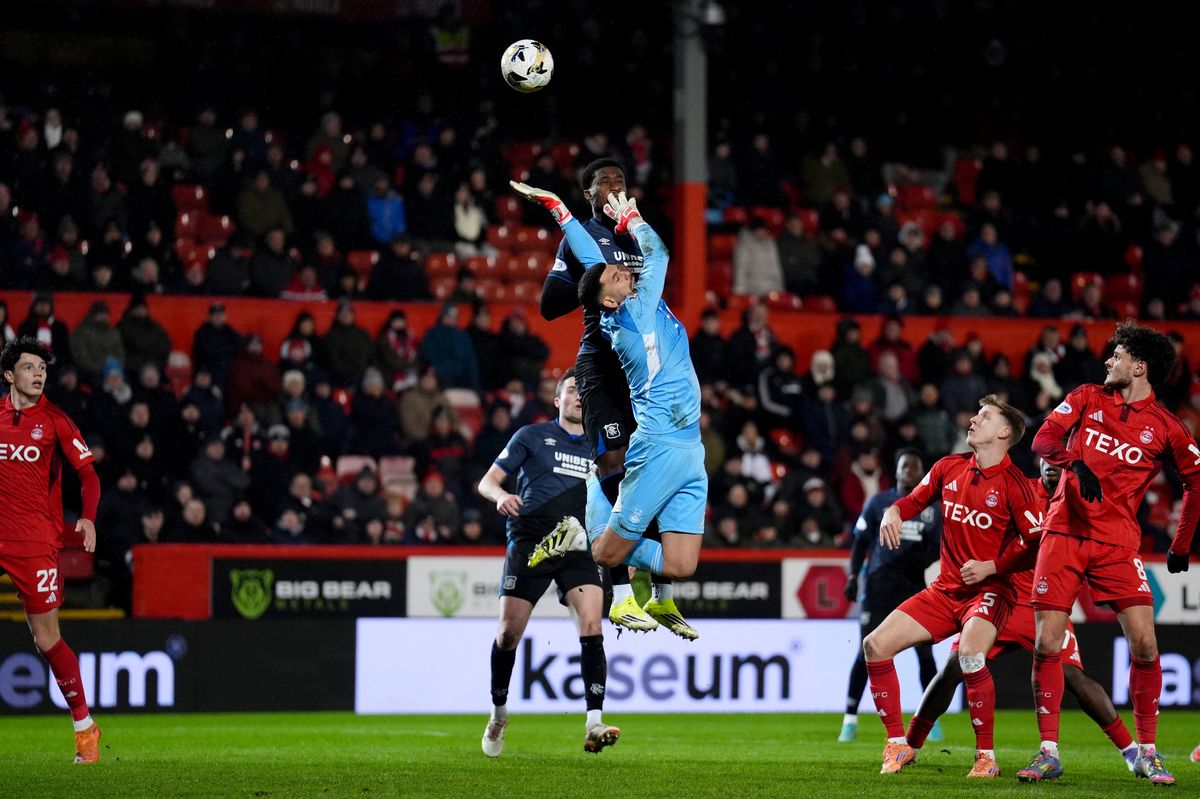
Fernandez rose. It was a leap of pure athleticism, the kind that makes you forget for a second that football is played on grass and not in the air. He outmuscled Aberdeen’s Dimitar Mitov, his forehead meeting the leather with a thud that echoed through the stadium. The net bulged. The Rangers end erupted in a sea of blue and orange.
But then came the silence.
The dreaded “silent check” from the VAR booth, manned by John Beaton, stretched from seconds into what felt like an eternity. Referee David Dickinson was summoned to the monitor—the modern executioner’s block for any goalscorer.
The Verdict
The “Jury”—a collection of former officials and analysts—later reached a unanimous, if reluctant, verdict: No Goal.
The reasoning? While Fernandez’s jump was clean in spirit, his trailing arm made contact with Mitov’s glove. In the hyper-sanitized world of modern officiating, a goalkeeper in the air is treated like a protected species. The contact, however minimal, was deemed enough to impede Mitov’s ability to claim the ball.
A Tale of Two Pundits: The Great Debate
If you want to understand the soul of Scottish football, you look at the reaction of the pundits. The “Jury” was unanimous on the rules, but they were worlds apart on the spirit of the game.
Kris Boyd, never one to hide his blue-tinted spectacles, was uncharacteristically measured. “Look, by the letter of the law, you can’t touch the keeper,” he noted in the Sky Sports studio. “But as a striker, that makes my blood boil. Fernandez wins the header. He’s bigger, he’s stronger. We’re turning the box into a no-contact zone.”
Chris Sutton, on the other hand, found himself in the rare position of agreeing with the Rangers contingent—sort of. “It’s a contact sport,” Sutton argued, his voice rising an octave. “If Mitov isn’t strong enough to hold his ground, that’s on him. But the VAR era has made every brush of a shirt a felony. It’s technically correct, but it’s a miserable way to referee a game.”
The Second Dissection: The Gassama Incident
While the Fernandez goal was the aesthetic highlight, the game’s clinical turning point arrived in the 74th minute. This time, VAR acted not as the villain for Rangers, but as the silent witness to justice.
Djeidi Gassama, dancing through the Aberdeen midfield like a man who had replaced his boots with silk slippers, was clipped by Graeme Shinnie. Initially, play continued. The Pittodrie roar urged the Dons forward. But the eye in the sky was watching.
The VAR review was swift. The contact was clear. Tavernier stepped up, converted the penalty, and the air went out of the Aberdeen balloon. If the first VAR call was a “grey area” of physical contact, the second was a black-and-white case of a mistimed tackle. It served as a reminder that for all its flaws, the technology often gets the big, objective moments right.
The Atmosphere: Beyond the Pitch
The match wasn’t just defined by what happened on the VAR screen. It was a raw, visceral encounter. Emmanuel Fernandez, despite his disallowed goal, was the focal point of the afternoon’s drama in more ways than one.
During the celebration of Thelo Aasgaard’s opening goal, Fernandez was reportedly struck by an object thrown from the stands. It was a jarring reminder of the thin line between passion and hostility. While the police later concluded there was no evidence of criminality to pursue, the incident added a layer of grit to an already tense afternoon.
The Resilience of Fernandez
What makes Fernandez’s performance so compelling is his burgeoning reputation as a “Teflon” defender. Just weeks prior, he had survived a “Ref Watch” inquiry following a clash with Celtic’s Arne Engels. Pundits had called for a red card for an accidental elbow, but the consensus—led by Dermot Gallagher—was that Fernandez was simply a “physical player playing a physical game.”
He is becoming the ultimate modern defender: a man who plays on the edge, tests the limits of the technology, and remains unfazed by the noise of the crowd or the glare of the VAR monitor.
The Aftermath: What Have We Learned?
As the dust settled on Rangers’ 2-0 victory, the conversation shifted from the three points to the state of the game. The “unanimous verdict” on Fernandez’s disallowed goal tells us three things about football in 2026:
- The Goalkeeper is King: Gone are the days of Nat Lofthouse-style challenges. If you breathe on a goalkeeper in the six-yard box, you are playing with fire.
- VAR is the Main Character: We no longer talk about the flight of the ball; we talk about the angle of the slow-motion replay. The “Jury” spends more time discussing frames-per-second than tactical shifts.
- Rangers Have Found a Warrior: In Emmanuel Fernandez, Rangers have a player who forces the officials to make a decision. He is a disruptor, a physical presence that Scotland’s referees are still figuring out how to handle.
Conclusion: The Beautiful, Broken Game
The “Jury” may have dissected the calls, and the pundits may have argued until they were blue (and green) in the face, but the reality of the Rangers-Aberdeen clash was a testament to why we watch. It was messy, it was controversial, and it was deeply human—even with the robots in the VAR room.
Emmanuel Fernandez left Pittodrie without a goal on the scoresheet, but he left as the most talked-about man in the country. In the end, perhaps that’s the greatest goal a player can score in the theater of Scottish football.
The Final Scorecard
| Feature | Analysis |
|---|---|
| Fernandez Goal | Technically a foul, spiritually a travesty. |
| VAR Efficiency | Slow, but ultimately followed the rulebook to the letter. |
| Man of the Match | Tavernier for his cool head, but Fernandez for his heart. |