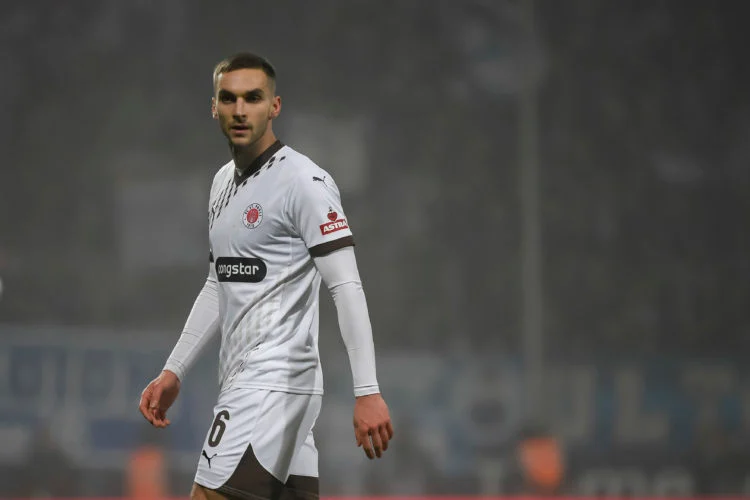
James Sands Faces Indefinite Spell on Sidelines Following Devastating Ankle Injury
James Sands has suffered a major setback in his career after sustaining a serious ankle injury during St. Pauli’s 1-0 victory over Freiburg. The USA international, currently on loan at the 2. Bundesliga club from New York City FC, fell awkwardly on his ankle in the final moments of the match, and the severity of the injury became immediately apparent. St. Pauli manager Alexander Blessin admitted post-match that it “looked really bad,” and now official reports have confirmed the worst. Sands has undergone surgery to repair a fractured fibula and torn medial collateral ligament, sidelining him indefinitely.
This injury comes at a particularly cruel time for Sands, who had been working to establish himself in Germany after previous stints in Scotland with Rangers and in Major League Soccer with NYCFC. Having just made the move to St. Pauli, he was looking to prove himself in European football once again and had already started making an impact for the promotion-chasing side. Now, with a long and uncertain recovery process ahead, Sands’ future with both St. Pauli and NYCFC remains unclear.
Severity of Injury and Recovery Timeline
NYCFC confirmed in an official statement that Sands sustained a complex ankle injury that required immediate surgical intervention at the University Medical Centre Hamburg-Eppendorf. The club has not provided an exact timeline for his return, stating only that he will be out “indefinitely.” Given the nature of both the fractured fibula and torn ligament, Sands is facing a lengthy rehabilitation period that could extend well beyond the current season.
Typically, a fibula fracture alone can take several months to heal, with an additional recovery period needed to regain full strength and mobility. However, the combination of a ligament tear further complicates the situation, as ligament injuries often require extensive physical therapy to restore stability and prevent future complications. Players with similar injuries have often required anywhere from six months to a full year to return to full fitness, meaning Sands could miss a significant portion of 2025 as well.
This raises questions about his long-term future at St. Pauli. The German club brought him in on loan to bolster their squad as they push for promotion to the Bundesliga, but with Sands now set to miss most—if not all—of the remainder of the campaign, it is unclear whether the club will keep him once his rehabilitation is complete. Similarly, NYCFC will have to decide whether to reintegrate him into their squad upon his return or consider moving him elsewhere once he recovers.
Impact on Sands’ International Career
Beyond club football, Sands’ injury is a major blow to his ambitions with the U.S. Men’s National Team. The timing could not be worse, as the USA is co-hosting the 2026 FIFA World Cup alongside Canada and Mexico. Sands, who has already earned caps for the national team, would have been hoping to solidify his place in Gregg Berhalter’s squad over the next two years. However, a long-term absence from competitive football could significantly damage his chances of making the final World Cup roster.
The competition for places in the U.S. squad is already fierce, particularly in defensive and midfield positions. With younger players emerging and others maintaining consistent form in Europe’s top leagues, Sands will need to prove himself all over again once he returns. The U.S. national team staff will undoubtedly monitor his rehabilitation closely, but being out of action for such a long period means he will have to fight even harder to regain his spot in the squad.
Reflections on His Time at Rangers and Career Progression
This is not the first major challenge Sands has faced in his career. His previous loan spell at Rangers was a mixed experience. He arrived at Ibrox in January 2022 and was part of the squad that made a remarkable run to the Europa League final, where they ultimately fell to Eintracht Frankfurt on penalties. While he contributed to some key moments in Europe, his domestic performances were more inconsistent. Sands struggled to secure a regular starting spot and was also part of the squad that saw their Scottish Premiership title hopes slip away to rivals Celtic.
Despite these difficulties, Sands has since spoken positively about his time in Scotland, acknowledging that it helped him grow as a player. “Rangers is such a big club in that league that in a lot of the home games, they are quite dominant with the ball,” he explained in an interview after leaving Ibrox. “They really are able to push the game forward, and then on the road, you know, maybe the field is not so good or whatever it might be, it becomes a lot more difficult. So learning how to get results in difficult places was one thing.”
He also highlighted how his time playing in different competitions—domestic leagues, cup competitions, and European matches—taught him how to adapt to varying styles of play. “The European games were a totally different experience again. So just trying to adapt to all the different levels, different types of players. It was my first time away from home, first time out of the United States. So, to think everything would have gone perfectly is, you know, a little unrealistic. I think it made me a better player and it helped a lot.”
What Comes Next for Sands?
Now, Sands faces perhaps the biggest challenge of his career—returning from a serious injury and proving himself once again at both club and international levels. The road to recovery will be long and demanding, requiring patience, discipline, and mental strength. Rehabilitation will likely include months of physical therapy, conditioning, and gradual reintegration into training before he can return to competitive action.
Much will depend on how both St. Pauli and NYCFC handle his recovery. St. Pauli’s promotion hopes may influence their decision on whether to keep Sands beyond his loan spell, as they may look to bring in fully fit reinforcements instead. Meanwhile, NYCFC will need to assess whether Sands can still be a key part of their squad moving forward. If his recovery goes well, there is still a chance that he could rebuild his career in Major League Soccer or secure another move to Europe.
For now, all Sands can do is focus on his rehabilitation and ensure he returns as strong as possible. The support from his club, family, and fans will be crucial in helping him through this difficult period. If he can come back fully fit and regain his form, there is still plenty of time for him to achieve his goals—whether that be helping a club compete for trophies or making it to the 2026 World Cup.
Conclusion
James Sands’ injury is a harsh reminder of how unpredictable football can be. Just as he was settling in at St. Pauli and looking to make an impact in Germany, he has been sidelined indefinitely with a serious ankle injury. His absence will be felt at club level, and his international aspirations have been put in jeopardy. However, Sands has already faced challenges in his career, and if he approaches his recovery with the same determination he has shown in the past, he has every chance of making a full comeback.
For now, all eyes will be on his rehabilitation and how he progresses in the coming months. The hope is that he will return stronger, ready to prove himself once again on the pitch. Until then, Sands’ future remains uncertain, but his resilience and work ethic will be key in shaping what comes next.