Blue Moon Blues: Guardiola’s “Defensive Nightmare” Deepens After Derby Demolition
MANCHESTER — The strobe lights of Old Trafford have long been unforgiving to the vanquished, but for Manchester City, the darkness following Saturday’s 195th Manchester Derby feels particularly oppressive. The scoreboard read 2-0 in favor of Michael Carrick’s revitalized Manchester United, a result that sent the Stretford End into rapture and left the traveling City contingent in stunned silence. Yet, as the dust settles on a damaging defeat that leaves the champions six points adrift of league leaders Arsenal, the true cost of the afternoon is only just becoming clear.
Pep Guardiola, the architect of City’s modern dominance, is facing a crisis that threatens to derail their title defense before the winter frost has even cleared. It is not a crisis of faith or philosophy, but of sheer physical attrition. The medical room at the City Football Academy is rapidly becoming the most crowded room in the building, and the casualty list reads like a “Who’s Who” of world-class talent.
The Foden Enigma: Tactical Switch or Broken Bone?
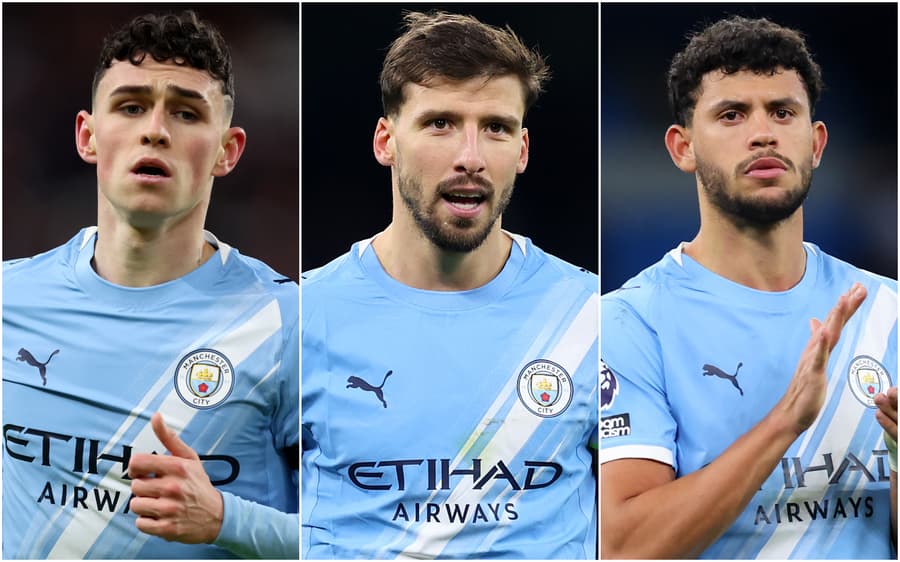
Perhaps the most alarming development from Saturday’s defeat concerns Phil Foden. The “Stockport Iniesta,” usually the heartbeat of City’s creative engine, was unceremoniously withdrawn at half-time. Initially, the substitution appeared to be a tactical roll of the dice from Guardiola—a desperate attempt to inject life into a side that looked uncharacteristically flat in the first 45 minutes.
In his post-match press conference, Guardiola stuck to this script. “It was tactical,” the Catalan manager insisted, his face a mask of frustration. “We needed to change the dynamic in the pockets.”
However, the visual evidence told a more concerning story. As Foden made his way out of Old Trafford, he was spotted with his right hand heavily bandaged, sparking immediate concern among the fanbase. Reports have since emerged suggesting that the England international suffered a broken hand following a nasty fall during the first half. He is currently undergoing scans to determine the severity of the fracture.
The timing could not be worse. Foden is now a major doubt for the midweek Champions League trip to Norway to face Bodø/Glimt on January 20. While a hand injury does not necessarily preclude a player from taking the field—football history is littered with players donning casts to play—the risk of aggravation in the physical cauldron of the Premier League is real. The medical staff will be working around the clock, with a tentative hope that he might be cleared for the crucial clash against Wolverhampton Wanderers on January 24.
The Crumbling Wall: A Defense Decimated
If Foden’s injury is a blow to the attack, the situation in defense can only be described as catastrophic. Guardiola famously builds his teams from the back, relying on ball-playing defenders who can strangle opposition attacks before they begin. But right now, his defensive wall is missing its most critical bricks.
The headline absence is Ruben Dias. The Portuguese center-back, widely regarding as the vocal leader of the backline, is currently sidelined with a hamstring strain sustained earlier this month against Chelsea. The diagnosis is grim: a 4-to-6-week layoff. This timeline rules him out until late February, with the club targeting the February 21 fixture against Newcastle United for his return. Without Dias, City lacked their usual organizational grit at Old Trafford, allowing United’s forwards to exploit gaps that the Portuguese international would typically seal shut.
Compounding the misery is the continued absence of John Stones and Josko Gvardiol. Stones, whose hybrid defender-midfielder role was the catalyst for the treble-winning season, is still weeks away from returning from a thigh injury, with a target date set for February. Meanwhile, Gvardiol is navigating the long, arduous road to recovery from a tibial fracture, with the Croatian not expected back until April or May—effectively ruling him out for the bulk of the title run-in.
This “perfect storm” of injuries left Guardiola with no choice but to field a makeshift backline against United. The reliance on youngsters like Max Alleyne and Rico Lewis, while admirable, proved fatal against an experienced United attack. Lewis, usually so composed, looked isolated, while Alleyne faced a baptism of fire that no young defender deserves in a derby of this magnitude.
The Nunes Blow and the “Flu” Factor
To add insult to injury, City’s tactical plans were thrown into disarray before a ball was even kicked. Matheus Nunes, who has been one of the revelations of the 2025/26 season, was ruled out on the eve of the match.
Nunes has reinvented himself this campaign, transitioning from a peripheral midfielder into City’s premier right-back. His athleticism and ability to carry the ball have added a new dimension to Guardiola’s flank play. However, the club confirmed that Nunes “felt bad” on Friday, succumbing to a virus or flu that swept through the camp. Unable to train, he was left at home.
The good news—perhaps the only good news of the weekend—is that Nunes’ absence is likely short-lived. Since the issue is illness rather than injury, he is expected to travel for the Bodø/Glimt game or, at the very least, be fully fit to face Wolves. But his absence at Old Trafford was palpable; without his drive on the right, City’s attack became narrow and predictable, playing perfectly into the hands of Carrick’s defensive setup.
A Title Race on a Knife-Edge
The context of these injuries makes the situation even more volatile. The Premier League title race is unforgiving, and Arsenal have shown no signs of blinking. The Gunners, watching from afar, will have relished the result at Old Trafford. The gap is now six points. In previous years, a six-point deficit in January would be seen as a minor inconvenience for the City juggernaut. But this City side feels different—more fragile, less inevitable.
Michael Carrick’s Manchester United exposed that fragility. They pressed high, isolated the inexperienced defenders, and capitalized on the lack of leadership at the back. It was a blueprint that other teams—specifically Wolves and Newcastle—will be studying closely.
Guardiola now faces a monumental task. He must navigate a treacherous run of fixtures with a squad stripped to its bare bones. The trip to Bodø/Glimt, played on an artificial surface in freezing temperatures, is a potential banana skin. Then comes Wolves, a side known for their physicality and ability to upset the “Big Six.”
Conclusion: The Test of Champions
”We cannot cry,” Guardiola said, though his eyes betrayed the weight of the situation. “We must find solutions. We are Manchester City.”
Finding solutions has always been Guardiola’s superpower. Whether it’s inventing the false nine or turning center-backs into midfielders, he has always found a way to win. But this challenge is different. You cannot invent a healthy hamstring for Ruben Dias or magically heal a broken bone for Phil Foden.
The next month will define Manchester City’s season. If they can weather this storm, patch together a defense, and hang onto Arsenal’s coattails until the cavalry returns in February, they may yet retain their crown. But if the injuries continue to mount and the points continue to drop, the 2-0 loss at Old Trafford may be remembered as the day the title finally slipped away.
For now, the blue half of Manchester holds its breath, waiting for the scan results, waiting for the return dates, and hoping that their nightmare is just a passing dream.