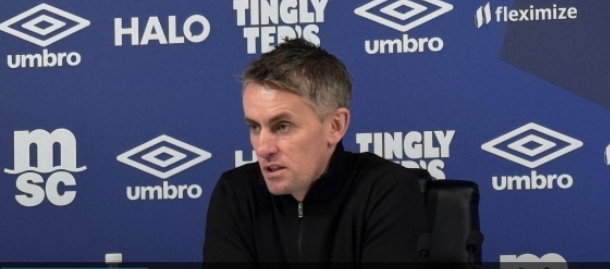
The Architecture of Altruism: Kieran McKenna’s Blueprint for Progress Following Blackburn Victory
In the high-octane environment of the 2026 Sky Bet Championship promotion race, a 3-0 home victory is often viewed as a “job well done.” For the 26,715 fans who packed Portman Road on Saturday, January 17, it was a celebratory afternoon that reinforced Ipswich Town’s status as a formidable force. However, for manager Kieran McKenna—a coach whose reputation is built on the minutiae of tactical perfection—the result was merely “another day of decent progress.”
McKenna’s post-match reflections offered a fascinating window into the psychology of a team that is no longer satisfied with just winning; they are obsessed with the way they win. While the headlines focused on the scoreline and the emotional return to the scoresheet for Sammie Szmodics, McKenna’s narrative was centered on “intent,” “execution,” and a specific brand of unselfishness that he believes will be the difference-maker in the final months of the season.
The Early Foundation: Intent vs. Fortune
The match began with a whirlwind intensity that has become a hallmark of the McKenna era. Within twelve minutes, the Blues had essentially secured the points, though the manner of the goals provided an interesting contrast. The opener in the 3rd minute was credited as an own goal by Blackburn’s Eiran Cashin, but McKenna was quick to credit the “intent” of Marcelino Nunez’s delivery.
By the 12th minute, Jack Taylor had doubled the lead, reacting quickest after a set-piece scramble. For Taylor, it was his first goal of the season, a milestone that McKenna noted with quiet satisfaction. However, the manager’s praise was reserved for the defensive structure that allowed these early flurries to matter.
“Good to get the early goals,” McKenna remarked. “I think defensively, our intensity in the first half was really, really good, never really dropped or gave the opposition a moment.”
This “intensity” is the bedrock of McKenna’s philosophy. It isn’t just about running; it’s about the intelligent application of pressure. McKenna noted that his side successfully navigated Blackburn’s tactical setup by playing “over” the pressure at times—using flick-ons and second balls to bypass the midfield—while also showing the technical quality to play “through” it when the spaces opened up.
The Perfectionist’s Critique: The Search for the “Killer” Instinct
Despite the comfortable lead, a palpable tension remained at Portman Road until the 88th minute. For a manager of McKenna’s profile, the gap between the second and third goals was a subject of scrutiny rather than relief. He admitted in his post-match address that he would have preferred the game to be “killed off” much earlier.
This critique isn’t born of negativity, but of a desire for clinical efficiency. Between the 12th and 88th minutes, Ipswich created several high-quality openings. Sindre Walle Egeli and Jack Clarke both forced excellent saves from Balazs Toth, and McKenna felt his side was denied a clear penalty. Yet, the lack of a third goal left the door slightly ajar for a Blackburn side that, while limited, possessed dangerous individuals like Yuki Ohashi.
“We weren’t as clinical as we should have been,” McKenna admitted. He pointed to moments in the second half where the team “switched off,” promising a rigorous review of those lapses. In the Championship, where momentum can shift on a single mistake, McKenna knows that “decent progress” requires a 90-minute blackout of the opposition’s hope.
The Szmodics Narrative: Breaking the Portman Road “Curse”
The emotional peak of the afternoon arrived in the 88th minute. Sammie Szmodics, scoring against his former employers, finally found the net at Portman Road—his first home goal since joining the club 18 months ago.
McKenna described it as a “strange record,” noting the irony that a player of Szmodics’ calibre had scored in prestigious stadiums across the country while remaining scoreless on his home turf. But more than the goal itself, McKenna was enamored with the type of goal it was. It wasn’t a piece of individual brilliance; it was a manifestation of the “team-first” culture McKenna has been meticulously building.
The Symbolism of Wes Burns
The goal was made possible by Wes Burns, who had beaten his man on the right and found himself in a position where most strikers would have opted for a shot. Burns, recently returned from injury and undoubtedly hungry for his own goal, chose instead to square the ball for Szmodics.
“It would have been easy for Wes to also want his first goal back at Portman Road since injury and to snatch at something or get anxious or get a little bit selfish on it,” McKenna explained. “And he leaves one across goal for a teammate.”
To McKenna, this was the “important message” he has been drumming home to his forward unit. He called it the “architecture of a guaranteed goal.” By turning a “pretty good chance” for one player into a “guaranteed goal” for another, the team elevates its collective ceiling. It is this psychological shift—from individual glory to collective execution—that McKenna believes defines a promotion-winning squad.
Tactical Summary: Ipswich Town 3 – 0 Blackburn Rovers
| Statistic | Ipswich Town | Blackburn Rovers |
|---|---|---|
| Score | 3 | 0 |
| Possession | 56% | 44% |
| Shots on Target | 8 | 2 |
| Key Man | Marcelino Nunez | Balazs Toth |
| Attendance | 26,715 | N/A |
Looking Ahead: The Path of Decent Progress
As the interview concluded, McKenna’s gaze was already shifting to the next challenge. He spoke of the “goals in the team” and the “goals in the squad,” suggesting that while some players might feel they should have more on their tally, the current trajectory is correct.
The victory over Blackburn was a microcosm of the McKenna era: tactically flexible, defensively disciplined, and increasingly selfless in the final third. By emphasizing the importance of Wes Burns’ decision-making over the final scoreline, McKenna is ensuring that his players stay grounded.
The message is clear: Three points are the requirement, but “decent progress” is the goal. As Ipswich continues its march toward the Premier League, it is these standards of unselfishness and clinical intent that will serve as their compass. Portman Road is no longer just a stadium; it is a classroom where McKenna’s students are learning that the shortest path to the top is often found by looking for a teammate in a better position.
Final Verdict: Ipswich Town’s 3-0 win was a professional display that highlighted their tactical superiority. However, McKenna’s insistence on a more clinical edge suggests that the “Blues” have several more gears to find as the season reaches its crescendo