On This Day: The “Law of the Ex” and the Beginning of the End for Malcolm Crosby
Football history is littered with stories of “the one who got away”—players discarded by managers only to return months later and deliver a cold, hard slice of humble pie. On January 16, 1993, Sunderland traveled to the compact, atmospheric surroundings of Twerton Park to face Bristol Rovers. It was a journey into the West Country that would prove to be a pivotal moment in the decline of one of Sunderland’s most liked, yet ill-fated, managerial eras.
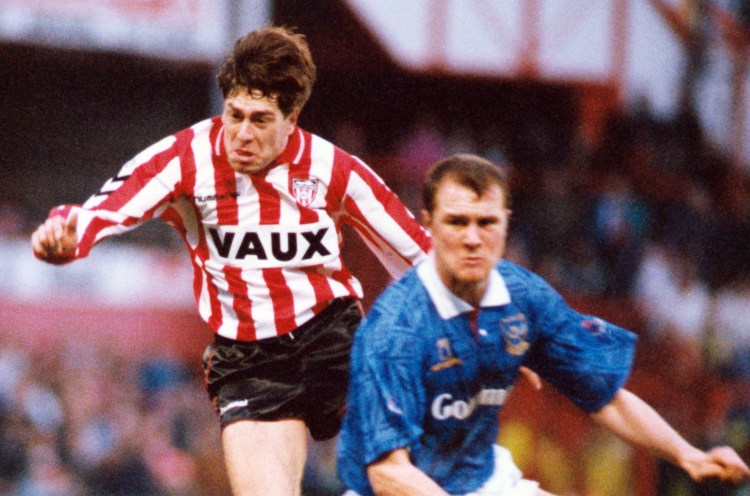
The headline that day was written by a man Sunderland fans knew all too well: Barrie Hardyman. In a classic case of the “Law of the Ex,” Hardyman secured his personal revenge against the man who had deemed him surplus to requirements, Malcolm Crosby, as the Black Cats were held to a frustrating 2-2 draw.
The Backdrop: A Club in Flux
To understand the significance of this 2-2 draw, one must look at the state of Sunderland AFC in early 1993. Just eight months prior, Malcolm Crosby had achieved the impossible. Taking over as caretaker after the sacking of Denis Smith, the mild-mannered Crosby had led a second-tier Sunderland side to the 1992 FA Cup Final.
The scenes at Hillsborough for the semi-final win over Norwich City remain legendary, and although they lost the final 2-0 to Liverpool, Crosby was the hero of Wearside. Under immense pressure from a sentimental fanbase, Chairman Bob Murray gave Crosby the job permanently.
However, by January 1993, the magic had faded. The “cup hangover” was real. Sunderland weren’t just struggling; they were treading water in the bottom half of the First Division (now the Championship), lacking the financial muscle to compete with the likes of Kevin Keegan’s Newcastle United, who were currently running away with the league.
The Protagonist: Barrie Hardyman’s Point to Prove
Barrie Hardyman was a solid, dependable midfielder who had served Sunderland well. Yet, in the eyes of Crosby, Hardyman wasn’t the man to take the club to the next level. He was sold to Bristol Rovers, a move that Hardyman reportedly took personally.
When the fixtures came out, this was the date the midfielder had circled in red. Twerton Park—then the temporary home of the “Gas” while they were away from Eastville—was a tight, hostile ground where the fans were practically on top of the pitch. It was the perfect stage for a grudge match.
Match Report: Drama at Twerton Park
Sunderland arrived in Bristol needing a win to stop a slide that was seeing them drift dangerously toward a relegation battle. They started brightly, showing the flashes of quality that had taken them to Wembley less than a year earlier.
Sunderland’s Scorers:
- David Rush: The diminutive striker, a local lad who always gave 100%, found the net to give the visitors hope.
- Shaun Cunnington: The hard-working midfielder added a second, and for a period, it looked like Crosby’s men would return to the North East with all three points.
But then came the inevitable. Bristol Rovers, spurred on by the “Azteca Twerton” atmosphere, fought back. The man leading the charge was none other than Hardyman. Playing with a point to prove, he dominated the midfield battle and eventually got his name on the scoresheet. It wasn’t just a goal; it was a statement.
The match ended 2-2, a result that felt like a defeat for Sunderland. They had the lead, they had the better players on paper, but they lacked the “killer instinct” that Crosby was increasingly criticized for missing.
The Fallout: The End of the Crosby Era
The 2-2 draw in Bristol was more than just a shared point; it was a symptom of a terminal illness in Crosby’s tenure. The “nice guy” image that had served him so well during the FA Cup run was now being used against him. Critics argued he was too soft on a squad that was underperforming.
The Statistics of Decline:
- Record: At the time of the Bristol Rovers game, Crosby had managed only 14 wins from 46 matches.
- The Shadow of St. James’ Park: While Sunderland struggled at Twerton Park, their rivals Newcastle were spending millions and playing “Total Football.” The contrast was unbearable for the Roker Park faithful.
Just a few weeks after this draw, following a 1-0 loss to Watford and a 1-1 draw with Bristol City, Bob Murray finally pulled the trigger. In February 1993, Malcolm Crosby was sacked. He was replaced by Terry Butcher, a move that signaled a shift toward a more “disciplined” and aggressive approach—though that, too, would eventually end in disappointment.
Historical Significance
Looking back 33 years later, the match on January 16, 1993, serves as a reminder of how quickly footballing fortunes can flip. Malcolm Crosby remains a beloved figure in Sunderland history—the man who gave the fans a Wembley day out they never expected. But football is a results business, and on that cold January afternoon in the West Country, Barrie Hardyman and the “Law of the Ex” proved that sentimentality doesn’t win points.
For Martin Wanless and the Sunderland fans who made the long trip down to Bristol that day, it remains a “what if” moment. What if they had held on? What if Hardyman hadn’t been sold? In the end, it was just another chapter in the roller-coaster history of Sunderland AFC.