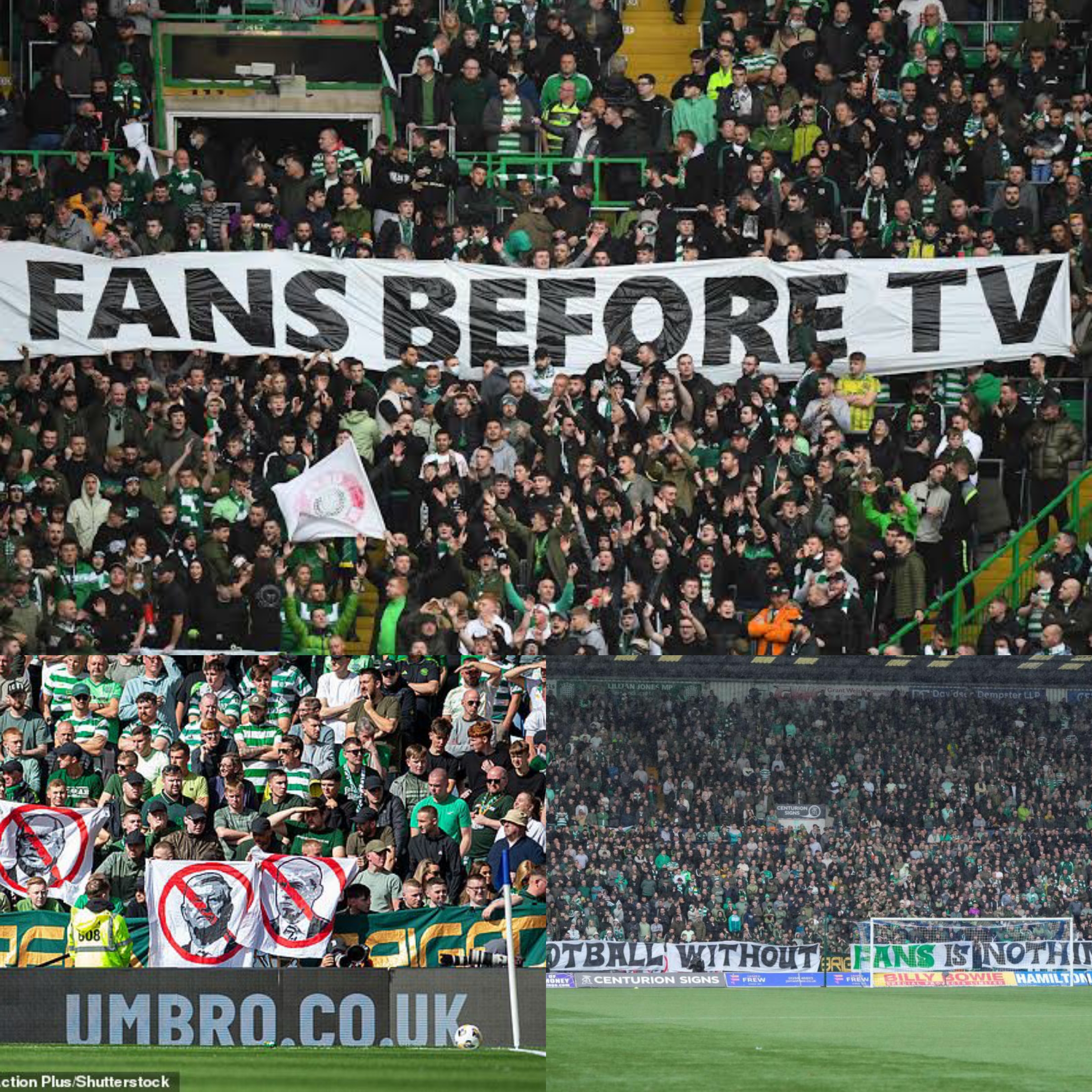
“We Are the Club”: The Rise of the Celtic Fans Collective and a Rebellion in Paradise
For over a century, Celtic Football Club has been more than a sporting institution. It is a cultural cornerstone, a community hub, a symbol of identity, resistance, and pride. From its roots in the East End of Glasgow to a global diaspora of supporters, the club has never just been about football. It has been about purpose, connection, and people.
But in 2025, those very people — the fans — are rising in rebellion. Not against players, not against results alone, but against a boardroom that they believe no longer represents the soul of Celtic Football Club. At the heart of this groundswell is a new protest movement: The Celtic Fans Collective.
📌 Origins: A Movement Born of Frustration and Failure
The emergence of the Celtic Fans Collective did not happen overnight. It is the result of years of simmering discontent, building steadily beneath the surface, even during times of domestic success. For many supporters, the disconnect between the club’s financial strength and its footballing ambition has become impossible to ignore — and unforgivable.
The 2025 Summer Window: The Final Straw
The tipping point came in the summer of 2025, when Celtic’s transfer activity — or lack thereof — created a storm of criticism. Manager Brendan Rodgers had, for months, made it clear that the squad needed bolstering in attacking areas if it was to make any impact in Europe.
Instead, the club failed to act decisively, leaving gaps in the squad that would ultimately contribute to another Champions League exit, the club’s seventh in nine qualifying attempts. The opposition? A team with a fraction of Celtic’s resources. The result? Anger, dismay, and, crucially, mobilisation.
💣 The Spark: The Open Letter and the Consultation Meeting
In the wake of this collapse, over 400 supporter groups and fan organisations signed an open letter to the Celtic board, demanding answers. Published on 3rd September 2025, the letter asked seven direct questions relating to:
Transfer policy
Governance structure
Financial priorities
Fan engagement
Decision-making processes
The roles of non-executive directors
The club’s long-term vision
The board’s response — described by many as “tone deaf,” “hastily assembled,” and “defensive” — only worsened the situation. Instead of offering transparency, it came across as an attempt to deflect criticism and protect entrenched leadership.
This moment of institutional arrogance catalyzed something rare in modern football — real organisation among supporters.
A consultation meeting was convened. Representatives from across the fan base attended. Out of that meeting came a unified voice — a plan, a structure, and a name.
🔰 The Celtic Fans Collective: Uniting the Support
The newly formed Celtic Fans Collective represents a major step forward in supporter activism. It is a movement grounded in unity, driven by structure, and aiming for permanence.
What makes this campaign unique is its breadth and legitimacy. The Collective is not a fringe group. It includes supporters’ associations, ultras, fan media, and geographic supporter clubs from Scotland, England, and Ireland. This isn’t a Twitter campaign — it’s a full-blown infrastructure of resistance.
The Steering Group
A second meeting formalised the movement’s steering group, which includes representatives from:
CSA (Celtic Supporters Association)
Affiliation of Celtic Supporters Clubs
AICSC (Association of Irish Celtic Supporters Clubs)
Celtic Disabled Supporters Association
The Celtic Trust
Green Brigade, Bhoys Celtic, and North Curve Celtic
Fans Against Criminalisation
Multiple fan media platforms
10+ regional supporters’ clubs
This broad coalition reflects a rare unity of purpose. In a fan base as large and diverse as Celtic’s, such cohesion is hard-won — and powerful.
🧭 Strategy: What the Celtic Fans Collective Wants
The Collective has issued a mission statement and a list of four clear objectives. These are not vague or performative. They are structured, strategic, and potentially transformative.
🎯 Objective 1: Transparency and Accountability
The Collective demands credible, transparent, and comprehensive answers from the board in response to the seven original questions from the open letter.
So far, the club has failed to provide anything close to that. The Collective will push for these answers through:
Matchday protests
Media engagement
Shareholder pressure at the AGM
Legal scrutiny of director performance
Supporters are no longer willing to accept silence or spin. They want the truth — and a plan for improvement.
🎯 Objective 2: Leadership Change
Perhaps the most ambitious demand is for personnel change at the top. The Collective has called for the removal of:
Michael Nicholson – Chief Executive
Peter Lawwell – Chairman (and former CEO)
Chris McKay – Chief Financial Officer
They also call for an audit of non-executive directors, questioning their roles, qualifications, and contributions.
This demand reflects not just frustration at failures — but a belief that Celtic’s current leadership structure is outdated, insular, and unfit for modern football. Critics argue that the club’s board has operated like a closed shop, with little external oversight and even less engagement with supporters.
🎯 Objective 3: A Fan Advisory Board
In the medium term, the Collective will campaign to establish a Fan Advisory Board — a formal, elected body with meaningful access to:
Club governance structures
Strategic decision-making
Financial planning
Communication channels with senior executives
This is not a “fan forum” or a ceremonial body. It is intended to be a serious mechanism of influence, ensuring that Celtic FC operates with the support and scrutiny of the people who sustain it.
🎯 Objective 4: A Permanent Democratic Movement
Beyond the current crisis, the Collective seeks to build a long-term democratic organisation to represent Celtic fans permanently.
This would be a legacy project — a lasting structure capable of:
Holding the board to account year-round
Responding to future crises
Participating in club development
Defending fan interests across issues from ticket pricing to policing
For a club as historically rooted in community as Celtic, this would be a return to values that have been eroded in the modern corporate era.
🧱 Building the Campaign: Tactics and Actions
The Collective has already begun organising on multiple fronts:
Matchday protests, including a delayed entry protest at Rugby Park and further demonstrations planned at Firhill and beyond.
Sub-groups have been formed to focus on:
Research and data collection
Legal and governance frameworks
Communications strategy
Media and fan outreach
AGM planning and shareholder mobilisation
Shareholder coordination ahead of the club’s AGM — a key moment to challenge the board in a formal setting.
The Collective is also using fan media and social platforms to bypass official channels and spread its message directly to the support base.
💼 Celtic’s Financial Success: A Double-Edged Sword
One of the more galling aspects of this situation for supporters is that the club is in its strongest-ever financial position. The 2025 accounts show:
£143.6 million in turnover
£33.9 million in profit after tax
Strong cash reserves and no pressing debt
So why, fans ask, does the club act as though it is in survival mode? Why is risk-averse austerity being dressed up as prudence, when real strategic investment is needed?
The Collective’s argument is clear: financial strength means nothing if it’s not used to compete on the pitch, especially in Europe — where Celtic’s record is now seen as embarrassing rather than underdog.
📈 A Club at a Crossroads
The emergence of the Celtic Fans Collective is more than a protest — it’s a reckoning. Celtic fans are demanding not just different results, but a different model of leadership.
They are drawing a line in the sand:
No more secretive governance
No more excuses for underinvestment
No more treating supporters like revenue streams instead of stakeholders
No more lowering of standards under the guise of “prudence”
They want a club that is ambitious, accountable, and aligned with its people. And if the board won’t deliver it, they are prepared to fight for it.
⚖️ The Road Ahead: Challenges and Opportunities
The Collective faces many obstacles:
Institutional resistance from the club’s leadership
Legal and procedural barriers to influence
Maintaining momentum across a broad and diverse supporter base
Navigating media narratives that may seek to portray them as extremists or unrepresentative
But they also have key advantages:
Widespread support from across the fan base
A legitimate cause grounded in Celtic’s founding values
Expertise and organisation — including legal, financial, and media knowledge