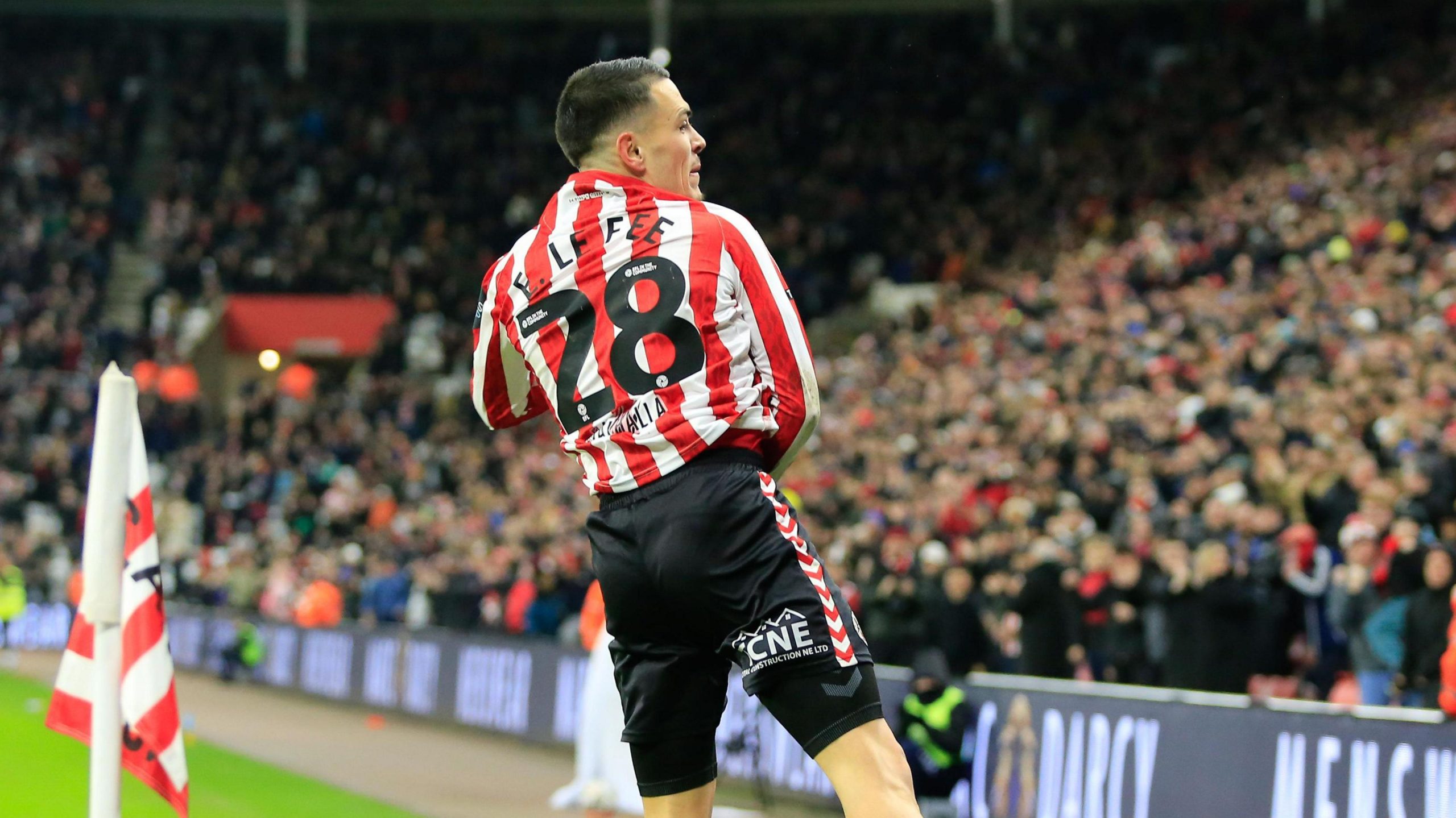
The Longest Walk in West London
To understand the beauty of Goodison Park on Saturday, you have to understand the humiliation of the Gtech Community Stadium on Tuesday.
There is no lonelier place in the world than the penalty spot when you’ve just tried a Panenka and failed. For Enzo Le Fée, Sunderland’s diminutive French maestro, the world didn’t just stop; it started laughing. With the Black Cats trailing 1-0 against Brentford and a chance to claw back into a vital Premier League fixture, Le Fée stepped up. He didn’t just miss; he insulted the goalkeeper with a dainty, floating chip that Caoimhin Kelleher caught with one hand while looking like he was checking his watch.
Sunderland went on to lose 3-0. The social media “Jury” was out, and they were sharpening the guillotines. “Too small for the league,” they chirped. “Arrogant,” they cried. “Another flashy Frenchman who doesn’t get it.”
But Philip West, writing for We Are Sunderland, saw something different. He saw a moment that would either break a player or forge a legend. What followed wasn’t just a game of football; it was a four-day psychological thriller that culminated in one of the most poetic nights in the club’s modern history.
“…Because We Are Sunderland And He Is Enzo Le Fée”
The headline of West’s now-viral analysis hits a nerve because it speaks to the soul of the club. Sunderland is a place that celebrates grit, honesty, and the “hard way.” It is a club that has suffered enough to recognize a kindred spirit when they see one.
When Le Fée arrived from Rennes for a hefty fee, there were whispers. Standing at just 5’7″ and possessing the delicate touch of a concert pianist, he didn’t exactly look like the kind of player who would enjoy a wet Tuesday in the North East or a physical scrap against Sean Dyche’s Everton.
Yet, as West noted:
“Against Everton, he showed that despite his diminutive build, he’s got a big heart and the resilience to match.”
This is the central paradox of Enzo Le Fée. He looks like he should be sipping espresso in a Parisian café, but he plays like he was raised in the shadow of the Wearmouth Bridge.
The Redemption: A Volley for the Ages
The FA Cup Third Round draw felt like a cruel joke. Everton away. Goodison Park—a place where flair often goes to die under a barrage of long balls and set pieces.
Régis Le Bris, the Sunderland manager who has coached Le Fée since the boy was ten years old at Lorient, did the bravest thing a manager can do: he doubled down. He started Le Fée. He gave him the keys to the midfield. He told him, in no uncertain terms, to be himself.
In the 30th minute, the “Panenka Prankster” vanished, and the “Little Prince” arrived.
A cleared corner fell to the edge of the box. The ball was spinning, awkward, and inviting. Most players of Le Fée’s stature would have looked to control it, to recycle possession, to play the “safe” pass. Instead, Le Fée leaned back, kept his over-the-ball composure, and lashed a right-footed volley that screamed into the top corner.
It wasn’t just a goal; it was an exorcism. He didn’t celebrate with a knee slide or a choreographed dance. He stood in front of the traveling Sunderland fans, chest out, arms wide, as if to say: “Are you not entertained?”
The Statistics of a Masterclass
Philip West’s dissection of the match highlighted more than just the goal. The data from the Everton win showed a player who had finally “cracked the code” of English football.
| Metric | Enzo Le Fée vs. Everton (FA Cup) |
|---|---|
| Pass Accuracy | 91% |
| Ground Duels Won | 8/11 (The highest on the pitch) |
| Interceptions | 4 |
| Distance Covered | 12.4km |
| Goals | 1 |
The most telling stat wasn’t the passing—it was the duels. For a “diminutive” player to win eight ground duels against an Everton midfield built like a line of nightclub bouncers is nothing short of miraculous. It proved that Le Fée wasn’t just a passenger; he was the engine.
The Ultimate Litmus Test: The Shootout
Football scripts are rarely this perfect. After a 1-1 draw in regulation time, the game headed to penalties.
The stadium held its breath. Everyone knew what happened on Tuesday. Everyone remembered the Panenka. If Le Bris was a gambler, he was betting his house on Le Fée’s mental strength.
Le Fée walked up first. The walk from the center circle to the penalty spot at the Gwladys Street End is roughly 40 yards, but for Enzo, it must have felt like 40 miles. The Everton fans were ruthless, chanting “Panenka” at the top of their lungs.
He didn’t chip it. He didn’t look for style points. He hammered the ball into the side netting with such venom that the net nearly tore. He turned to the crowd, put a finger to his lips, and walked back. Sunderland won the shootout 3-0.
The transformation was complete.
The Le Bris Connection: More Than a Manager
Philip West’s article touches on a crucial element of this story: the father-son bond between Régis Le Bris and Le Fée. In the modern, cold world of professional football, this kind of loyalty is rare.
Le Bris knew that if he dropped Le Fée after the Brentford disaster, he might lose the player for the season. By playing him, he told the entire squad—and the fans—that one mistake does not define a Sunderland player.
“Enzo is a technician, yes,” Le Bris said in the post-match presser. “But he is a competitor. In France, we call it ‘grinta.’ He has the soul of a Sunderland player wrapped in the feet of a magician.”
Conclusion: Why We Love the Game
The story of Enzo Le Fée and the “Jury” verdict on his resilience is why we watch football. We watch for the mistakes that make us scream and the redemptions that make us cry.
Philip West’s piece wasn’t just about a game of football; it was about the identity of a city. Sunderland fans don’t ask for perfection—they’ve lived through enough “Netflix” dramas to know that perfection is a myth. They ask for effort. They ask for heart.
Enzo Le Fée might be small in stature, but as he stood on the Goodison Park turf, soaking in the adulation of the Mackem faithful, he looked ten feet tall.
He is Enzo Le Fée. And they are Sunderland. It turns out, they were made for each other.
The Verdict
- The Goal: 10/10 for technique.
- The Penalty: 11/10 for “cojones.”
- The Future: Bright, French, and very, very exciting.