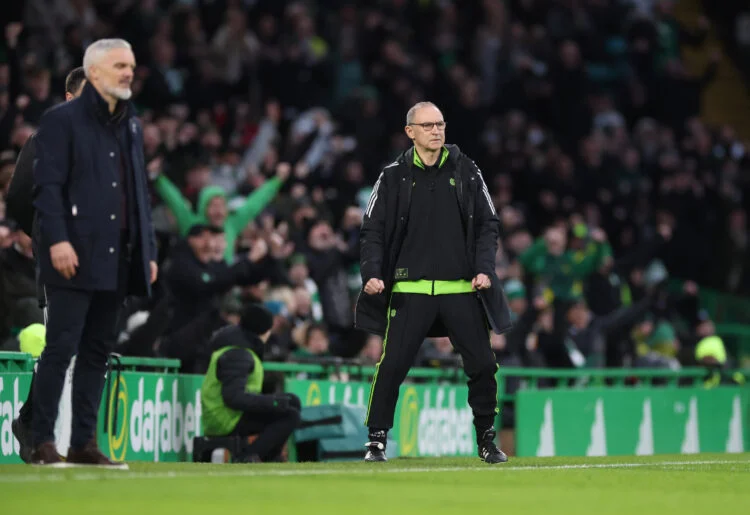
On Saturday, January 10, 2026, Celtic Park bore witness to a transformation that felt both like a new beginning and a homecoming. Following a chaotic and ultimately disastrous 33-day tenure under Wilfried Nancy—which culminated in a bruising 3-1 Old Firm defeat to Rangers—the board turned to a familiar face to steady the ship.
The return of Martin O’Neill for his second spell of the season (and third overall) provided the immediate “bounce” the club craved. The 4-0 demolition of Dundee United was more than just a scoreline; it was a tactical recalibration. Here is an in-depth analysis of how O’Neill has restored Celtic’s identity and what he is doing differently to sharpen their pursuit of league-leaders Hearts.
The Context: From ‘Nancy’s Chaos’ to O’Neill’s Order
To appreciate the 4-0 win, one must understand the “torrid tenure” of Wilfried Nancy. During his brief eight-game stay, Celtic lost six times—the highest defeat tally in over a decade. Nancy’s attempt to implement a rigid, complex 3-4-3 system left the players looking tactically misaligned and physically drained.
When O’Neill stepped back into the dugout on Monday, January 5, his mission was simple: De-clutter. He recognized that the squad, featuring stars like Reo Hatate, Daizen Maeda, and Arne Engels, was drowning in tactical instructions.
1. Tactical Simplification: Returning to the 4-3-3 Root
The most immediate change under O’Neill has been the abandonment of the experimental three-at-the-back system. Against Dundee United, Celtic returned to a structured but fluid 4-3-3.
- Defensive Stability: Under Nancy, Celtic’s backline often looked exposed on the counter. O’Neill restored Liam Scales and Auston Trusty to a more traditional center-back pairing, supported by Kieran Tierney and Alistair Johnston as conventional full-backs.
- The Result: A first clean sheet since O’Neill’s previous caretaker spell in October. By simplifying the defensive roles, Celtic played with a higher line of confidence, knowing their positioning was secure.
2. Wide Men and Verticality: The “O’Neill Way”
While Brendan Rodgers focused on patient, “metronomic” circulation, O’Neill has injected a sense of urgency. The win against Dundee United showcased a team that was significantly more vertical.
- Exploiting the Flanks: O’Neill’s strategy centered on using the pace of Hyun-jun Yang and Daizen Maeda. Instead of constant sideways passing, the instructions were clear: get the ball wide, isolate the full-back, and deliver.
- The Opening Goal: The breakthrough in the 27th minute was a textbook example. A direct ball from Liam Scales found Yang at the edge of the box, who bypassed his marker with the kind of directness that had been missing for months.
3. Reclaiming the “Power Midfield”
A major criticism of the previous regime was that Arne Engels and Callum McGregor were being “over-coached,” asked to cover too much ground in a thin two-man midfield.
O’Neill’s “new” approach has given the midfielders more defined roles:
- McGregor as the Anchor: Sitting deeper to disrupt play and protect the defense.
- Engels as the Engine: Given the freedom to drive into the box. This was validated when Engels doubled the lead just five minutes after Yang’s opener, arriving late in the area to capitalize on Celtic’s relentless pressure.
- The “Tounekti” Factor: Sebastian Tounekti has been utilized as a creative spark, drifting between the lines to create the “anxiety around the visitors’ six-yard box” that the official match reports noted was so prevalent on Saturday.
4. Restoring Fitness and the “High Intensity” Press
Under Nancy, the famous “Celtic Press” had vanished, replaced by a passive mid-block that allowed opponents time on the ball. O’Neill has demanded a return to the high-intensity physical game.
The match stats against Dundee United tell the story of a team that outworked their opponents:
- 78% Possession
- 22 Shots to 3
- 11 Corners
By winning “second balls” and pinning Dundee United into their own final third for nearly 90 minutes, O’Neill demonstrated that Celtic’s best defense is a relentless offense.
The “O’Neill Effect” on Individual Performances
The coach hasn’t just changed the system; he has restored individual confidence. Daizen Maeda, who had looked isolated under the previous regime, was “back to his best,” capped by a clinical right-footed strike for the fourth goal. Meanwhile, substitute Benjamin Nygren found the net, suggesting that O’Neill is successfully integrating the squad depth that he previously claimed needed strengthening.
Looking Forward: A Title Race Re-Ignited
Despite the 4-0 rout, Martin O’Neill remains a realist. In his post-match comments, he warned that the squad still needs “people in” during the January window to sustain a title challenge.
However, the win has moved Celtic into 2nd place, jumping over Rangers on goal difference and sitting just three points behind leaders Hearts. By focusing on verticality, defensive simplicity, and high-intensity pressing, O’Neill hasn’t just fixed the results; he has restored the “Hoops” identity.
The “Nancy Catastrophe” is over. Under O’Neill, Celtic are no longer a club in turmoil—they are a champion looking to reclaim their crown.