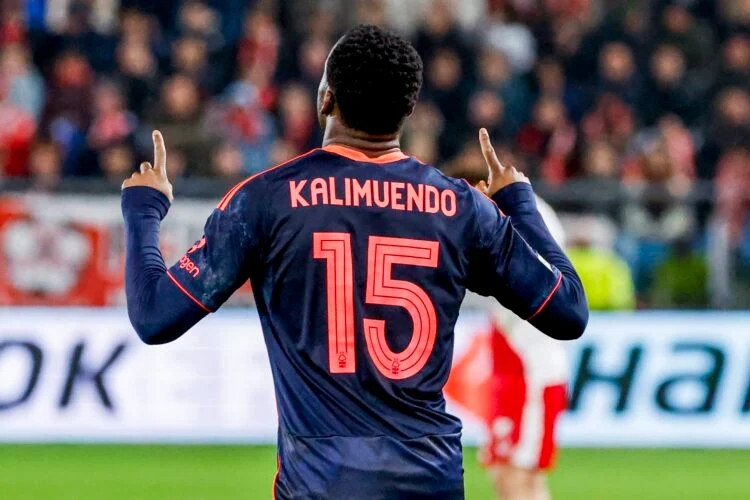
The Shadow of Kalimuendo: Why Nottingham Forest’s Striker Hunt is Stirring Debate
The January 2026 transfer window has barely creaked open, yet Nottingham Forest finds itself embroiled in a familiar and frustrating debate: the search for a striker capable of consistently finding the back of the net. The ghost of Arnaud Kalimuendo, the recently departed forward now on loan at Eintracht Frankfurt, looms large over the discourse, with whispers suggesting Forest’s “number one target,” Jørgen Strand Larsen of Wolves, might be no significant improvement. It’s a narrative that speaks volumes about the club’s recent struggles in the attacking department and the immense pressure on new global head of football, Edu, to get this crucial decision right.
Kalimuendo’s departure to the Bundesliga on a loan-to-buy deal, reportedly worth £23.5 million, marked the end of a disappointing chapter at the City Ground. Arriving with a respectable reputation from PSG, the French forward failed to ignite, managing a paltry two goals during his tenure. For a club desperate to establish itself in the upper echelons of the Premier League, such a return from a significant investment is simply unsustainable. His exit, while perhaps a necessary clearing of the decks, has inadvertently set a low, yet highly scrutinized, bar for his successor.
Enter Jørgen Strand Larsen. The 6’4″ Norwegian international, currently plying his trade at Wolves, has emerged as the clear frontrunner on Sean Dyche’s wishlist. Dyche, known for his pragmatic approach and preference for a strong, athletic number nine, reportedly sees Strand Larsen as the ideal focal point for his attacking system. On paper, the attributes align: he’s physical, possesses a decent work rate, and at times, has shown flashes of genuine quality. His 14 goals last season for Wolves painted a picture of a burgeoning talent.
However, the current campaign has told a different story. Prior to a recent hat-trick in the FA Cup against lower league opposition, Strand Larsen had managed a solitary Premier League goal in 19 appearances. This stark dip in form, coupled with an asking price that has reportedly soared to an eye-watering £40m–£50m, has ignited fierce debate among pundits, fans, and former players alike. The central question reverberating through the footballing world is pointed: is a player struggling for goals in the top flight, who statistically offers little more than the recently discarded Kalimuendo, truly worth such an exorbitant sum?
Simon Jordan, the outspoken football pundit, has been particularly vocal in his criticism, labeling the potential fee as “ridiculous” and questioning the logic behind pursuing a player whose current output does not justify the valuation. Such sentiments highlight the double-edged sword of the modern transfer market. Clubs are often forced to pay a premium for perceived potential, especially for players with the physical profile sought by managers like Dyche. Yet, the risk of overpaying for unproven or inconsistent talent remains ever-present, particularly for clubs like Forest, who cannot afford to repeatedly miss the mark on their significant investments.
The pressure on Edu is immense. This window represents his first real test in his new, expansive role at the club. His remit is not merely to identify talent, but to implement a coherent, sustainable transfer strategy that avoids the pitfalls of previous windows. The ghost of Kalimuendo is not just about the player himself, but about the broader narrative of Forest’s recruitment post-promotion. Too many signings have flattered to deceive, failing to integrate or deliver consistent performances. Edu’s success will be judged on whether he can break this cycle and bring in players who genuinely elevate the squad.
Beyond Strand Larsen, Forest reportedly has a contingency plan. The depth of the club’s scouting network, now overseen by Edu, is being thoroughly tested. Names like Youssef En-Nesyri of Fenerbahçe, known for his aerial prowess and experience, are circulating as more proven, albeit potentially older, alternatives. The powerful Ukrainian striker Artem Dovbyk of Roma, a player with a burgeoning reputation for clinical finishing, represents a potentially record-breaking outlay, signifying a bold ambition if Forest were to pursue him seriously. Then there’s Mehdi Taremi of Olympiacos, a more experienced, short-term option, perhaps facilitated by the shared ownership links between the two clubs.
Each of these targets presents a different profile, a different price point, and crucially, a different level of risk. The critical challenge for Forest’s recruitment team is to balance the manager’s stylistic preferences with the imperative of securing tangible improvement in a notoriously difficult position to fill.
The “no better than Kalimuendo” narrative isn’t just about Jørgen Strand Larsen; it’s a symptom of deeper anxieties. It’s a fear of repeating past mistakes, of squandering precious resources on a player who fails to move the needle. It’s a challenge to Edu to prove that his vision for Forest’s future recruitment is not just about big names or big fees, but about smart, strategic acquisitions that deliver on the pitch.
Ultimately, the success of Forest’s January striker hunt will be measured in goals, points, and performances. If Strand Larsen arrives and fires them up the table, the whispers will subside. But if he struggles, the shadow of Arnaud Kalimuendo will undoubtedly lengthen, casting a long, critical gaze over the City Ground’s transfer dealings once more. This window isn’t just about signing a striker; it’s about signaling a new, more effective era of recruitment for Nottingham Forest.