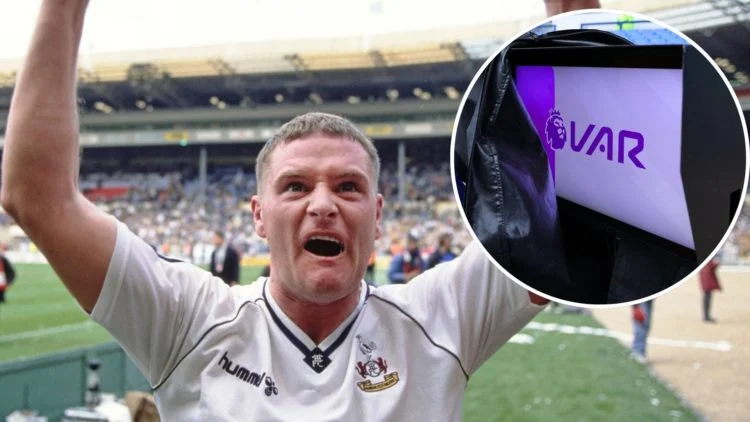
How VAR Could Have Changed the 1991 FA Cup Final for Nottingham Forest
The 1991 FA Cup final between Nottingham Forest and Tottenham Hotspur remains one of the most memorable and controversial in the competition’s history. For Forest, it ended in heartbreak as Des Walker’s own goal in extra time handed Spurs a 2-1 victory. However, with modern technology, particularly the introduction of VAR, the outcome of that match could have been drastically different.
The final was full of contentious moments, with incidents involving Paul Gascoigne, Mark Crossley, and Gary Lineker that could have seen different results had they been reviewed under today’s rules. Football, as we know, is often decided by fine margins, and in the case of the 1991 FA Cup final, those margins might have been altered significantly with the intervention of video assistance.
The Gascoigne Challenge: A Defining Moment?
One of the biggest talking points of the game came within the opening minute when Paul Gascoigne lunged into a reckless tackle on Nottingham Forest midfielder Garry Parker. The challenge was high, dangerous, and, by today’s standards, an almost certain red card. Yet, Gascoigne was not even shown a yellow card, allowing him to continue playing.
Reflecting on the match in 2020, Premier League referee Chris Kavanagh analyzed the incident for The Times and was clear in his verdict:
“I look at that cold and it’s a red card, but as I put my referee head on, it’s 43 seconds in, and I’ll probably not want to give a red so early, I’d like to give the game a chance to breathe.”
While referees in the early ‘90s often gave players the benefit of the doubt early in games, Kavanagh acknowledged that, with VAR in use, Gascoigne would have been sent off without question:
“VAR would get involved and it would result in a red card, VAR is factual. I’d go across to the screen and look at the angles and it would be a red.”
Had Gascoigne been dismissed, the game would have taken a completely different shape. Spurs, reduced to 10 men from the first minute, would have struggled to apply the same pressure on Forest throughout the match. Given the quality of Forest’s side at the time, there is every reason to believe that Brian Clough’s men could have managed the game and held on to their lead.
Furthermore, Gascoigne’s influence on the game extended beyond just his presence on the pitch. Shortly after his reckless challenge on Parker, he made another poor tackle—this time on Gary Charles—which led to the free-kick from which Stuart Pearce scored Forest’s opening goal. Ironically, that moment of brilliance from Pearce was the result of Gascoigne’s reckless play.
However, if he had been sent off for the first foul, the second challenge would never have happened, meaning the course of the game could have been even more unpredictable.
A Decision That Could Have Hurt Forest: The Mark Crossley Incident
While Gascoigne’s early dismissal could have benefited Nottingham Forest significantly, there was another major decision that VAR might have ruled in favor of Spurs.
Shortly after Pearce gave Forest the lead, Tottenham won a penalty following an incident involving Forest goalkeeper Mark Crossley and striker Gary Lineker. Crossley brought Lineker down in the box, but the referee awarded the penalty without showing a card to the Forest keeper.
Remarkably, Crossley went on to save Lineker’s penalty, keeping Forest in front. This moment was seen as a major let-off for Clough’s team, especially given how crucial it was to the match. However, looking back, Kavanagh believed that Crossley was lucky to stay on the pitch under 1991 rules:
“That has to be a red card, again—is it because it’s a Cup Final? Under today’s double jeopardy rules it would be a yellow card because it’s an attempt to win the ball. But in 1991, that’s a red card.”
Had VAR been in place, there is a strong argument that Crossley would have been sent off for denying a clear goalscoring opportunity. In that case, Forest would have been down to 10 men, forced to bring on a substitute goalkeeper, and likely facing a much steeper challenge against a Tottenham side with momentum.
It is worth noting that modern football laws have changed to avoid what is known as the “double jeopardy” rule, meaning that a genuine attempt to play the ball in a penalty incident results in a yellow card instead of red. However, in 1991, that was not the case, and VAR would likely have seen Forest lose their goalkeeper.
A Game of Sliding Doors Moments
When looking at the two biggest refereeing decisions of the final—the Gascoigne challenge and the Crossley penalty incident—it is fascinating to consider how VAR could have affected the match.
If Gascoigne had been sent off within the first minute, Spurs would have been at a massive disadvantage, making it easier for Forest to control the game. However, if Crossley had been sent off for his foul on Lineker, the advantage might have swung completely in Tottenham’s favor.
These moments highlight the unpredictability of football and the debate around the use of VAR in historical contexts. Would VAR have made the game fairer, or would it have simply altered the course of events in ways that are impossible to predict?
The Legacy of the 1991 FA Cup Final
Despite the heartbreak of that night at Wembley, Nottingham Forest’s history was not defined by the defeat. Des Walker, despite his unfortunate own goal, remains one of the club’s greatest defenders. Stuart Pearce’s leadership and commitment were never questioned, and Brian Clough’s legacy as one of football’s greatest managers was already secure.
However, the final remains a source of frustration for Forest fans who wonder what might have been. The club has not reached another FA Cup final since, making 1991 their last real shot at FA Cup glory.
Now, in the present day, Nottingham Forest find themselves once again competing in the latter stages of the FA Cup. As they prepare to face Brighton in the quarter-finals, they have the chance to finally return to Wembley for the first time since that fateful day in 1991.
While VAR might have changed the past, it will certainly play a role in the present, and Forest fans will hope that this time, the technology works in their favor.
Conclusion: The Impact of VAR on Football’s Biggest Moments
Football is full of ‘what ifs,’ and the 1991 FA Cup final is a perfect example of how small decisions can shape history. Had VAR been available, the entire game could have been altered—potentially in Forest’s favor, but also possibly making things worse.
Some fans believe that VAR is essential for ensuring fairness, while others argue that it takes away from the drama and unpredictability that make football so special. Either way, the 1991 final serves as a reminder that even decades later, moments of controversy remain a huge part of the game’s rich history.
For Nottingham Forest, the quest for FA Cup glory continues. With modern technology in place, perhaps this time, fortune will favor them.