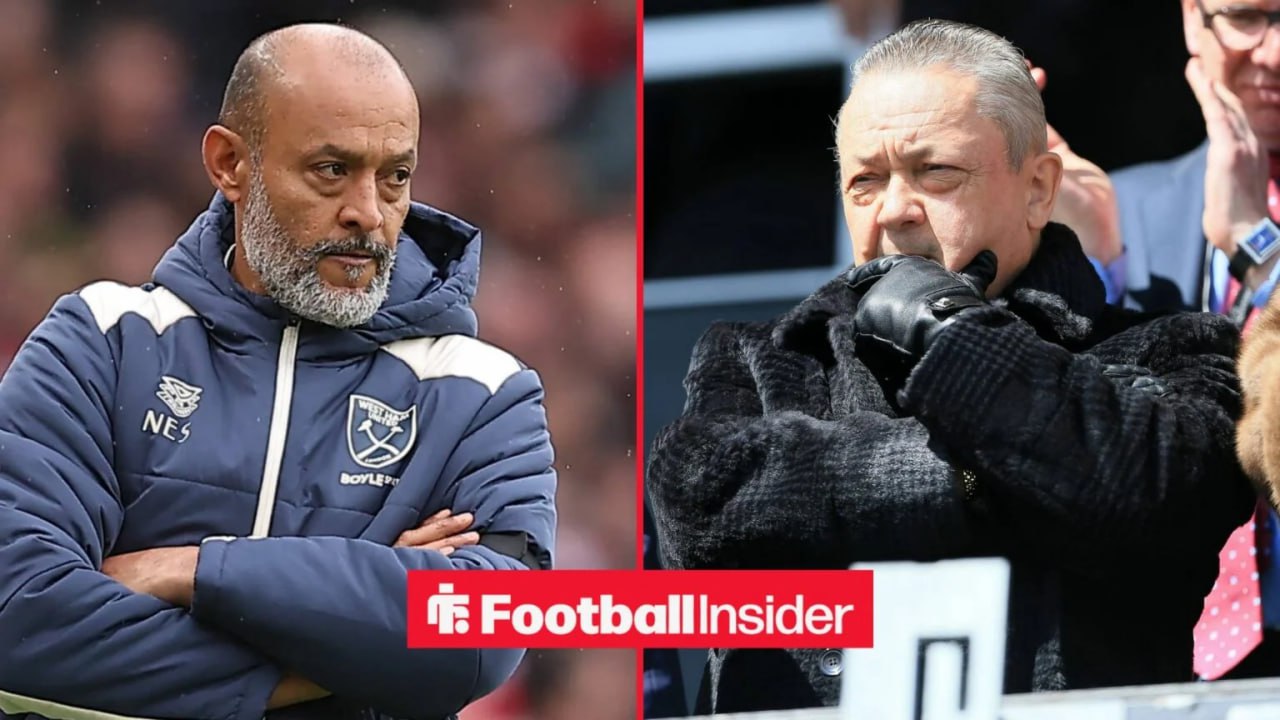
West Ham will get relegated’: Insider points finger at board – not Nuno Espírito Santo – as crisis deepens at West Ham United F.C.
West Ham United’s fight for Premier League survival has taken on an increasingly ominous tone, with one former insider claiming relegation was “inevitable” due to decisions made at the very top of the club — and insisting manager Nuno Espírito Santo is not to blame.
Despite signs of life in recent performances, the Hammers remain trapped in the relegation zone following a defeat to Liverpool F.C.. Results elsewhere offered little consolation: rivals Nottingham Forest F.C. and Tottenham Hotspur F.C. also slipped up, meaning the table remains tightly packed at the bottom.
But while survival is still mathematically achievable, former West Ham scout Mick Brown has delivered a stark verdict: if the club goes down, responsibility lies squarely with the board.
“I said they’d go down within two years”
Brown revealed he predicted West Ham’s decline back in 2024 when he departed the club. At the time, it may have sounded extreme. Now, it appears alarmingly plausible.
“When I left, I said to some people ‘West Ham will be relegated within two years’,” Brown stated. “Even at the time I thought that might be a bit soon — but look where they are now.”
His criticism is not directed at the current squad or the coaching staff. In fact, Brown has praised Nuno for steadying performances in recent weeks, suggesting the Portuguese coach has improved organisation and spirit during a turbulent period.
Instead, the accusation is clear: poor strategic leadership has eroded the foundations built during the successful era under David Moyes.
From European nights to relegation fears
It was not long ago that West Ham were enjoying memorable European campaigns and consistent mid-table stability. Under Moyes, they combined defensive resilience with clear recruitment strategy, adding players who fit a defined system.
Since then, however, continuity has fractured.
Managerial changes, inconsistent transfer policies and financial uncertainty have created instability. According to Brown, the cumulative effect of those decisions has left the club exposed.
“The way the club has been run, it was almost inevitable they wouldn’t maintain that success,” he argued. “If you put together the pros and cons, you’d run out of paper listing the bad decisions.”
Fan protests against ownership have intensified over the past year, reflecting growing dissatisfaction with co-owner David Sullivan and vice-chair Karren Brady. The atmosphere at the London Stadium has become tense, with supporters increasingly vocal about governance concerns rather than solely on-pitch results.
Nuno’s difficult inheritance
When Nuno Espírito Santo took charge, he inherited a fragile squad low on confidence and facing mounting external pressure. Rebuilding morale mid-season is rarely straightforward, particularly when structural issues loom in the background.
Recent performances have shown marginal improvement. The defensive shape looks more coherent, and several players appear reinvigorated. But the points gap remains daunting.
“The performances have picked up,” Brown admitted. “Nuno is doing a good job and the players are stepping up. But they’re still the ones doing the chasing.”
In relegation battles, momentum often proves decisive. Being in pursuit rather than control can drain belief quickly. West Ham’s margin for error is shrinking with each passing week.
The financial cliff edge
Relegation would not simply represent sporting disappointment — it could trigger severe financial consequences.
After 13 consecutive years in the Premier League, the revenue drop between divisions would be dramatic. Estimates suggest losses exceeding £60 million in broadcasting and commercial income.
Even survival may not eliminate financial strain. Concerns over liquidity and recent losses have already sparked fears that key assets may need to be sold to stabilise accounts.
Among the club’s most valuable players are captain Jarrod Bowen and emerging talent El Hadji Malick Diouf. Both could attract significant interest should West Ham require immediate cash injection.
Losing players of that calibre would compound instability and risk prolonging any rebuild.
A pivotal final stretch
The next two months will define West Ham’s trajectory for years to come.
If Nuno guides them to safety, credit will largely fall on the players and coaching staff for overcoming adversity. But as Brown insists, failure would reflect deeper structural shortcomings rather than individual mistakes on the pitch.
Relegation rarely stems from a single cause. Instead, it is often the endpoint of incremental misjudgements — recruitment gambles that fail, delayed investment, reactive managerial appointments, or strategic drift.
For West Ham, the narrative forming is one of erosion rather than collapse.
The bigger question: what next?
Even if the Hammers survive, the underlying issues will not disappear. Governance reform, clearer football strategy and financial transparency may be necessary to restore trust among supporters.
Should the worst happen, the Championship would present both opportunity and peril. Parachute payments would cushion the blow temporarily, but immediate promotion is never guaranteed.
One thing is certain: the stakes extend far beyond this season’s league table.
West Ham’s identity over the past decade has been shaped by Premier League stability and occasional European ambition. Relegation would not just end that run — it would symbolise the consequences of mismanagement at a critical moment in the club’s modern history.
As the final fixtures approach, Nuno Espírito Santo faces the challenge of defying predictions and rescuing pride. But according to those who have seen the inner workings firsthand, the deeper reckoning may lie above the dugout rather than inside it.