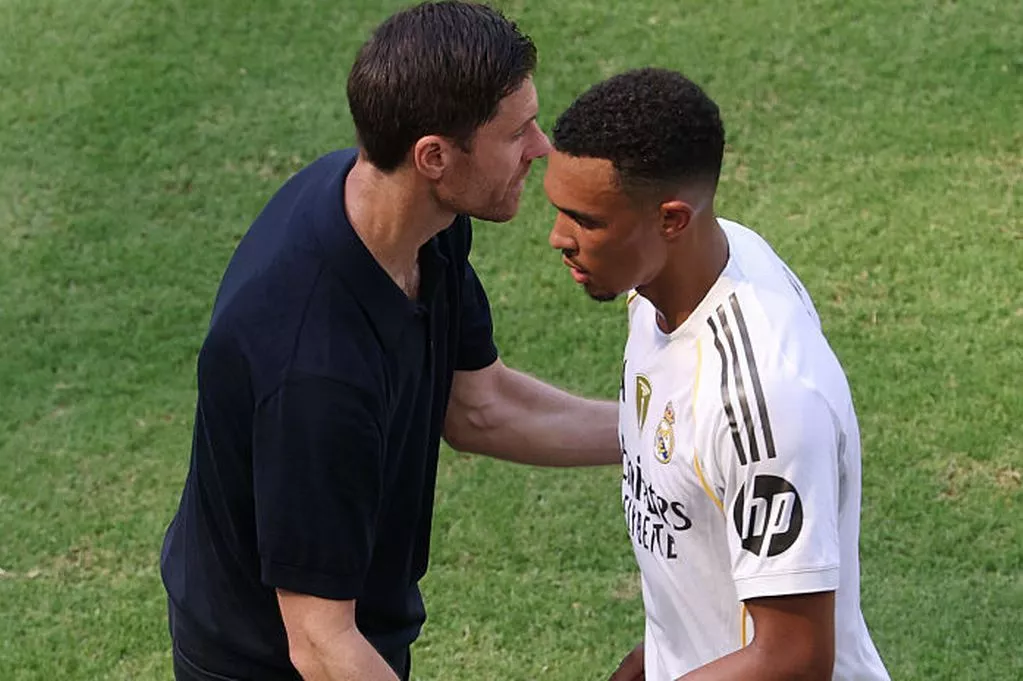
The Unraveling Dream: Xabi Alonso’s Exit and Trent Alexander-Arnold’s Precarious Future at Real Madrid
By [zion/247sportcity]
January 12, 2026 – Madrid, Spain
The pristine, manicured turf of the King Abdullah Sports City in Jeddah, Saudi Arabia, had barely absorbed the sweat and tears of a hard-fought Supercopa de España final. Just hours after a agonizing 3-2 defeat to arch-rivals Barcelona, a seismic tremor ripped through the foundations of Real Madrid. Xabi Alonso, the prodigal son who had returned to manage the club just over seven months ago, was out. Mutual consent, the official statement read, a polite euphemism that rarely masks anything but disappointment and a rapid shifting of sands. For the football world, it was a shock. For one particular player, however, it was an existential crisis unfolding in real-time: Trent Alexander-Arnold.
The story of Trent Alexander-Arnold’s move to Real Madrid was never just about a transfer fee or a contract. It was a narrative woven with ambition, tactical innovation, and a deeply personal connection. It was Xabi Alonso’s project, a daring vision to redefine the role of a full-back and unleash one of the sport’s most gifted passers on the grandest stage. Now, with Alonso gone, that meticulously constructed dream threatens to unravel, leaving Alexander-Arnold in a precarious, unenviable position at the biggest club in the world.
The Architect of a Dream: Alonso’s Vision for Trent
When Real Madrid announced Xabi Alonso as their new manager in May 2025, succeeding a legendary figure whose time had simply run its course, the football world buzzed with anticipation. Alonso, fresh from a triumphant spell at Bayer Leverkusen where he’d crafted a dynamic, fluid system, was seen as the ideal blend of tactical astuteness and a deep understanding of Madrid’s unique culture. His first major transfer coup, sealed amidst a swirl of speculation and frantic negotiations, was securing Trent Alexander-Arnold from Liverpool.
For years, Alexander-Arnold had been a lightning rod for debate. A generational talent with a right foot capable of unlocking any defense, his creative genius from the full-back position had redefined what was possible. Yet, equally persistent were the criticisms of his defensive vulnerabilities, a perceived Achilles’ heel that many argued prevented him from being a truly complete player. At Liverpool, Jürgen Klopp had built a system that largely mitigated these weaknesses, but the scrutiny remained.
Alonso, however, saw not a weakness to be hidden, but a strength to be amplified. His vision for Alexander-Arnold at Real Madrid was audacious: to position him as a primary playmaker, almost a deep-lying enganche from the right flank, free to orchestrate attacks with his unparalleled range of passing. It was a tactical gamble, an acknowledgment that in modern football, the traditional lines between positions were blurring, and that a player of Trent’s offensive caliber was too valuable to confine to purely defensive duties.
”Trent is a footballer of immense intelligence and vision,” Alonso had declared in a press conference shortly after Alexander-Arnold’s arrival. “He sees passes others don’t, and he has the technical quality to execute them. My job is to create a system where his strengths can flourish, where he can be the creative force we all know he can be.”
This wasn’t just football speak; it was a blueprint. Alonso immediately designated Alexander-Arnold as the team’s primary corner-taker, a seemingly small detail that signaled a massive shift in responsibility. He was given license to drift infield, to dictate tempo from deep, and to become the creative heartbeat of Madrid’s right side. Training sessions under Alonso were reportedly tailored to Alexander-Arnold’s unique attributes, focusing on positional play that would allow him to exploit pockets of space and link up with the attacking triumvirate ahead of him.
The Honeymoon Period and the First Cracks
The early weeks of the 2025/26 season offered glimpses of Alonso’s grand design. Alexander-Arnold, wearing the iconic white, displayed moments of breathtaking creativity, reminiscent of his best form at Anfield. There were defense-splitting through balls, whipped crosses that found their targets with uncanny precision, and a growing understanding with Vinicius Jr. and Rodrygo. The Spanish press, always quick to both praise and crucify, initially lauded Alonso’s tactical courage and Alexander-Arnold’s audacious talent.
But the honeymoon period was fleeting. Real Madrid is a club where the weight of expectation is crushing, and the margins for error are razor-thin. When results began to falter, particularly in high-stakes matches, the familiar criticisms of Alexander-Arnold’s defensive work resurfaced, magnified tenfold by the unforgiving glare of the Spanish media. A misplaced pass leading to a counter-attack, a moment of indecision in tracking back – these were dissected with forensic intensity.
Xabi Alonso, however, stood as a steadfast shield. In press conferences, he would consistently defend his marquee signing, absorbing the criticism himself rather than allowing it to destabilize Alexander-Arnold. “We are building something here,” Alonso would patiently explain. “Trent is an integral part of that. We win as a team, and we learn as a team. His contribution offensively is invaluable, and we are working tirelessly on all aspects of our play.”
This unwavering support was more than just a managerial duty; it was a personal commitment. Alexander-Arnold had chosen Madrid, in part, because of Alonso. As a young player at Liverpool, he had watched Alonso orchestrate play from midfield with a masterful touch, a figure he reportedly idolized. The opportunity to learn from and play for his hero was a powerful draw, cementing a bond that went beyond professional allegiances. Alonso was Alexander-Arnold’s tactical patron, his personal buffer against the relentless pressure cooker of the Bernabéu.
The Supercopa and the Final Straw
The Supercopa de España final against Barcelona in Jeddah became a microcosm of Madrid’s season under Alonso: moments of brilliance, periods of vulnerability, and ultimately, heartbreak. A 3-2 defeat to their fiercest rivals, compounded by some individual errors, proved to be the final straw. For the Madrid hierarchy, accustomed to perpetual success, a trophy-less first half of the season, culminating in a loss to Barcelona, was simply unacceptable. The ruthless demands of the Bernabéu swallowed another promising project whole.
And with Alonso’s departure, Alexander-Arnold’s world at Real Madrid was immediately plunged into uncertainty. The architect was gone, and the blueprint he had drawn for Trent now looked like a discarded sketch.
The Immediate Aftermath: Loss of a Tactical Shield
The most immediate and critical impact of Alonso’s exit for Alexander-Arnold is the loss of his tactical shield and primary advocate. Alonso was the manager willing to construct a system around Trent’s unique strengths, prioritizing his offensive output while finding ways to manage his defensive limitations within a collective framework. He was the one who saw the vision, invested in it, and staunchly defended it.
Without Alonso, Alexander-Arnold loses the one manager who consistently overlooked or strategically minimized the “defensive deficiencies” that have plagued his career narrative. In a league known for its tactical rigor and a club famous for demanding excellence in every facet of the game, Alexander-Arnold’s defensive game will likely come under even more intense scrutiny. The “buffer” provided by Alonso’s unwavering support and tailored tactics has vanished, leaving Alexander-Arnold exposed.
Enter Álvaro Arbeloa: A Shift in Philosophy?
Real Madrid’s immediate response to Alonso’s sacking was the appointment of Álvaro Arbeloa as interim manager, promoted from his role as coach of the Castilla (Real Madrid B team). While Arbeloa is a beloved figure at the club, a former Madrid defender who embodies the “Madridista” spirit, his appointment presents a stark contrast to Alonso’s tactical philosophy, particularly concerning the role of full-backs.
Arbeloa, during his playing career, was the epitome of a traditional, defensively solid full-back. He was disciplined, hardworking, and prioritized defensive duties above all else. This background suggests a managerial approach that may lean towards pragmatism and defensive solidity, especially in the short term.
- Prioritizing Defense: It is highly probable that Arbeloa, at least initially, will seek to tighten up Madrid’s defense. This could lead to a less adventurous role for the full-backs.
- The Dani Carvajal Factor: This shift in philosophy could significantly favor Dani Carvajal, the veteran right-back who embodies defensive reliability and an aggressive, traditional full-back role. Carvajal, a consistent performer, would offer Arbeloa the defensive security he might prioritize. Alexander-Arnold, who has only started five La Liga matches this season due to a combination of injuries and tactical benching, faces an uphill battle to displace him.
- Systemic Change: Alonso’s system was designed to give Trent freedom. Arbeloa’s system might demand more positional discipline and defensive responsibility, potentially stifling Alexander-Arnold’s creative impulses if he is forced into a more rigid role that doesn’t play to his strengths.
The challenge for Alexander-Arnold under Arbeloa will be immense. He will have to prove not just his offensive prowess, but a significant improvement in his defensive application and positional awareness to gain the trust of a manager who fundamentally hails from a different school of thought regarding the full-back position.
Whispers of a Premature Departure
Even before Alonso’s dramatic exit, the murmurs of discontent and transfer speculation surrounding Alexander-Arnold had begun to grow louder. Spanish tabloids, always eager for a juicy story, had started to report on Alexander-Arnold’s struggles to fully integrate into the team and adapt to the intensity of La Liga.
Now, with his main champion gone, these whispers are set to amplify into a roar.
- A “Project” Without its Leader: Alexander-Arnold joined Real Madrid largely because of Alonso. The opportunity to be part of a new, exciting project led by a manager he respected and whose tactical vision aligned with his own ambitions was a key factor. Without that personal and professional connection at the helm, his long-term commitment to the “new generation” project at the Bernabéu may be severely tested.
- Transfer Rumors: Already, speculative reports, some bordering on the outlandish, have emerged. Clubs like Chelsea, reportedly keen on a creative right-back, have been linked to a potential loan or even a permanent move for Alexander-Arnold in the summer of 2026. While such rumors are often premature, they highlight the precariousness of his situation. If Alexander-Arnold finds himself consistently on the bench under Arbeloa, a move away to find regular first-team football would become a very real possibility.
- Adapting or Departing: Alexander-Arnold will have two stark choices: either adapt his game significantly to suit a potentially more conservative tactical approach under Arbeloa (or a future permanent manager), or seek a move elsewhere where his unique skillset can be fully unleashed once again. The latter option, unthinkable just seven months ago, is now a distinct possibility.
The Broader Implications for Real Madrid
Alonso’s exit and Alexander-Arnold’s subsequent struggles also have broader implications for Real Madrid’s transfer strategy and managerial appointments. The club had invested heavily in Alonso’s vision, bringing in players like Alexander-Arnold to fit a specific tactical framework. If Alexander-Arnold were to depart prematurely, it would represent a significant financial and sporting loss, highlighting the risks of building a team too closely around a single manager’s philosophy.
Furthermore, the pressure on Álvaro Arbeloa is immense. He must stabilize the ship, ensure Champions League qualification, and try to win a trophy. His decisions regarding key players like Alexander-Arnold will be scrutinized, and his ability to integrate or reinvent players inherited from a different tactical regime will define his tenure.
The Road Ahead: A Defining Period
For Trent Alexander-Arnold, the next few months will be the most defining of his burgeoning career. He arrived at Real Madrid with the weight of expectation and the promise of a glorious new chapter, hand-picked by a managerial legend. Now, that chapter has taken an unexpected, dramatic turn.
He faces the challenge of proving his worth to a new manager who may not share the same tactical philosophy, in a team that will be under immense pressure to perform. He must either demonstrate a newfound defensive robustness to complement his attacking genius, or fight for a role that allows his extraordinary passing range to shine without compromising the team’s defensive integrity.
The dream of Xabi Alonso and Trent Alexander-Arnold at Real Madrid was daring, innovative, and ultimately, tragically short-lived. Now, with the architect gone, Alexander-Arnold stands at a crossroads, his future at the Bernabéu – and perhaps his career trajectory – hanging precariously in the balance. The unraveled dream might yet be rewoven, but it will require immense resilience, tactical adaptation, and perhaps, a dose of fortune, to navigate the choppy waters ahead. The world watches, waiting to see if Trent Alexander-Arnold can still write his own glorious chapter in the white of Real Madrid, or if this ambitious transfer will be remembered as a magnificent, albeit fleeting, experiment