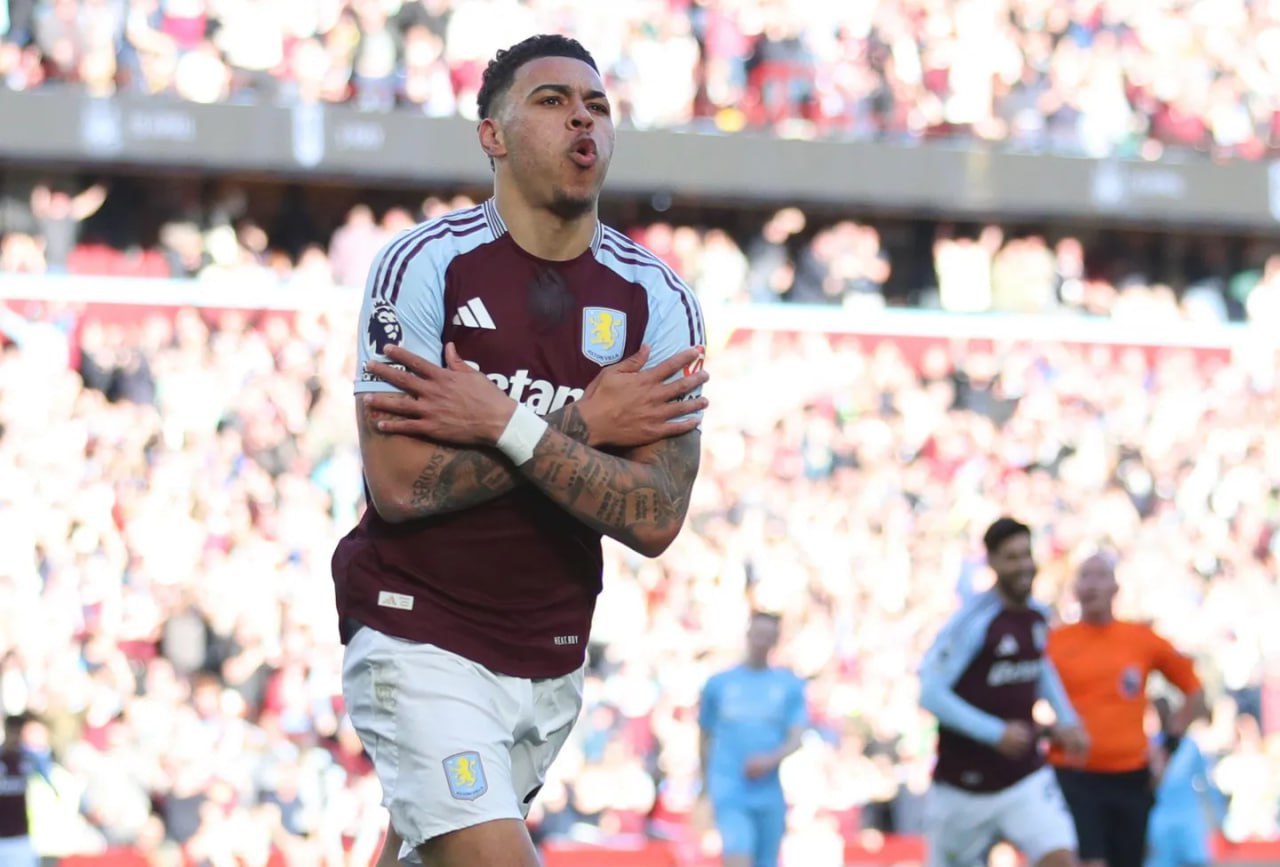
Aston Villa’s season remains one of the Premier League’s most intriguing stories. Few expected Unai Emery’s side to sustain a serious push near the summit after narrowly missing out on Champions League qualification last term, particularly given financial limitations and a difficult start to the campaign. Yet for much of the autumn, Villa defied expectation — sitting just three points off leaders Arsenal F.C. at the beginning of December.
Now, however, the narrative has shifted. Two wins in eight league matches have stalled momentum. Performances have grown more laboured. And perhaps most tellingly, the goals have slowed.
The solution to Villa’s attacking stutter may not require a major tactical overhaul. Instead, it might hinge on one decisive adjustment involving Morgan Rogers — specifically, moving him back to the left flank.
The numbers behind the frustration
On paper, Villa’s position still looks impressive. But underlying metrics paint a more cautious picture. Emery’s side sit 15th in the Premier League for Expected Goals (xG), an alarming statistic for a team competing in the top six. They are the only club in that bracket whose xG ranking does not mirror their league position.
That discrepancy suggests overperformance — clinical finishing masking structural issues in chance creation.
Villa have scored 38 league goals, with 16 of those coming from Rogers and Ollie Watkins combined. While Emiliano Buendía and John McGinn have chipped in, Emery’s wide players have not consistently delivered the attacking thrust required to sustain a Champions League push.
The problem is not simply one of finishing; it is one of fluency.
Emery’s system and its current limitations
Emery’s preferred 4-2-3-1 setup typically revolves around central overloads. One winger tucks inside to combine in congested areas while the opposite flank provides width and verticality. It is a structure designed to control possession and manipulate defensive shapes.
Rogers, ranked among the world’s elite attacking midfielders this season, has largely operated as a No.10 since the turn of the year. From that position, he links play intelligently and contributes defensively by pressing from the front — an attribute Emery values highly.
However, with injuries to key midfield figures such as Boubacar Kamara and Youri Tielemans disrupting balance, the central areas have often become crowded but ineffective. Opponents have adapted accordingly.
Both Leeds United F.C. and Wolverhampton Wanderers F.C. recently deployed back-three systems with two screening midfielders, congesting Villa’s preferred central zones. The result? Limited space for Rogers to operate between the lines and fewer high-quality chances created.
Against Wolves at Molineux, frustration was visible. Rogers threw his arms up when Watkins failed to latch onto a through-ball and later became involved in a heated exchange with defender Yerson Mosquera. It was an uncharacteristically emotional display from a player who had previously been Villa’s creative spark.
A reminder of what worked
Rewind to December, and the picture looks very different.
Operating from the left wing, Rogers was arguably the Premier League’s standout performer for a spell. He scored braces against both Manchester United F.C. and West Ham United F.C., tormenting defenders with direct dribbling and incisive movement.
From the flank, Rogers thrives in a hybrid role. He begins wide but drifts inward, attacking the half-spaces with speed and unpredictability. Crucially, this positioning allows him to face defenders one-on-one — something he cannot do as easily when stationed centrally amid heavy traffic.
His statistical output from wide areas reinforces the argument: four goals and two assists in eight league starts on the left. More importantly, Villa’s overall attacking rhythm appeared sharper when he stretched play before cutting inside.
The ripple effect on Watkins
Rogers’ repositioning could also directly benefit Ollie Watkins.
Watkins remains a tireless runner and clever channel operator, but he relies heavily on service delivered early and into space. When Rogers operates centrally, Villa often lack natural width on the left, narrowing passing lanes and enabling defences to compress around Watkins.
From the flank, Rogers can draw defenders outward before slipping passes into Watkins’ path — or driving inside to shoot himself. That unpredictability makes it harder for opponents to double-mark the striker.
The brief spell against Wolves when Tammy Abraham was introduced offered a glimpse of this dynamic. As Rogers shifted left, Villa suddenly looked more threatening. His dribbling stretched Wolves’ shape, and space opened between the lines.
Although that tactical tweak was short-lived, it hinted at what might be possible with a sustained commitment to the change.
A squad built for adaptability
Villa’s recent transfer decisions have had mixed consequences. The departure of Donyell Malen and return of Leon Bailey altered attacking balance, while other wide options have struggled for consistency.
Emery now faces a defining period, with crucial league clashes ahead and a Europa League last-16 tie against Lille OSC looming.
In high-stakes matches against direct Champions League rivals, fine margins matter. Villa do not necessarily need more possession; they need clearer attacking patterns.
Releasing Rogers back to the left might restore a degree of spontaneity and width that has been missing.
The bigger picture
Morgan Rogers’ goals have often been spectacular — long-range strikes or moments of individual brilliance that exceed their xG value. That ability to conjure something from nothing is invaluable.
But relying on spectacular finishes is not sustainable. Villa require repeatable chance creation.
Sometimes the solution to stagnation lies not in signing new players or reshaping entire systems, but in reactivating what once worked.
For Aston Villa, that could mean a simple yet significant adjustment: freeing Morgan Rogers from the congestion of central midfield and allowing him to rediscover the form that once made him the league’s most electrifying wide attacker.
If Emery is willing to make that one bold call, Villa’s stuttering attack may yet roar back to life at precisely the right moment in the season.