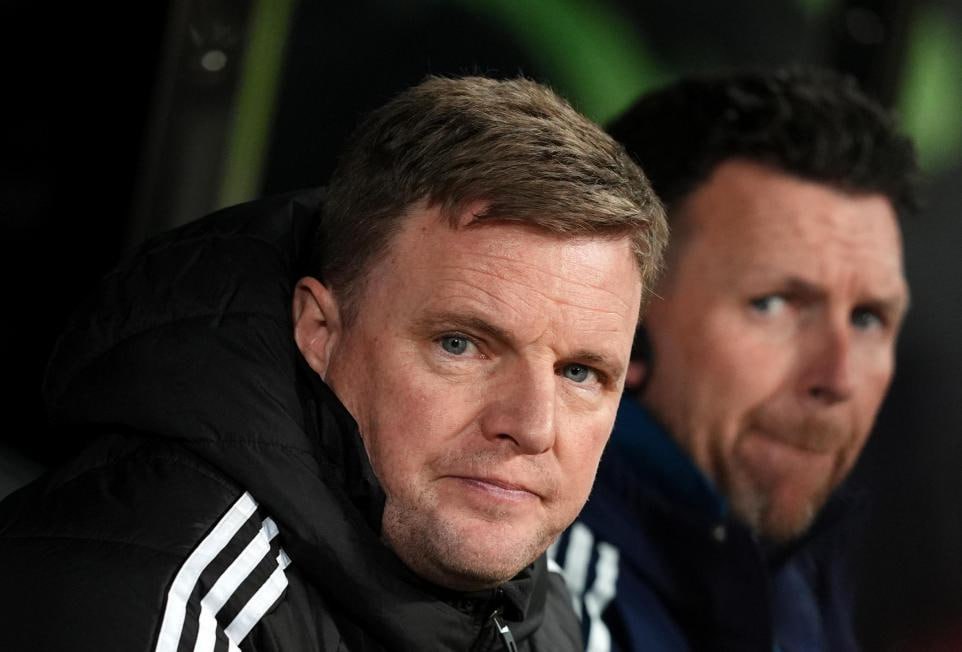
Eddie Howe on Newcastle United F.C.’s European Balancing Act: “You Learn by Doing It”
Eddie Howe has delivered a candid assessment of Newcastle United’s attempt to juggle Champions League football with the relentless demands of the Premier League — insisting that while it is not impossible to compete on both fronts, it is unquestionably difficult.
As the Magpies prepare to host Manchester United F.C. at St James’ Park, Howe’s side find themselves navigating familiar but unforgiving territory. Newcastle are through to the last 16 of the Champions League, yet domestically they sit 13th in the Premier League table.
For a club that has fought hard to re-establish itself among Europe’s elite, the dual challenge has stretched resources to their limits.
“I Don’t Like the Word Impossible”
When asked whether clubs outside the traditional “big six” can realistically balance Champions League commitments with domestic consistency, Howe refused to accept defeatism.
“I don’t like the word ‘impossible’ regarding what we can achieve,” he said. “That gives everyone a way out or an excuse.”
His message was clear: difficulty does not equate to inevitability.
Yet he did not downplay the scale of the task.
Two seasons ago, Newcastle’s previous Champions League campaign ended with a seventh-place Premier League finish. This season tells a similar story — strong European progression, but domestic inconsistency.
The comparison with Aston Villa F.C. is telling. Villa qualified for the Champions League last year but could only manage sixth in the league, highlighting how even upwardly mobile clubs struggle to sustain performance across four competitions.
The Hidden Cost of Extra Games
Wednesday’s fixture against Manchester United will mark Newcastle’s 46th game of the campaign.
By contrast, Manchester United will play only 40 matches in all competitions this season — a six-game difference that represents a significant physical and mental load.
Howe pointed to the cumulative strain:
- Extra midweek travel
- High-intensity European fixtures
- Reduced recovery windows
- Increased injury risk
He admitted that fatigue has played a role in inconsistent league performances.
“There’s no doubt players have gone into games tired and fatigued,” Howe acknowledged. “Maybe just one or two percent off — and that’s all you need at this level.”
At elite level, marginal declines translate into tangible consequences. A missed press. A slower recovery run. A lapse in concentration.
Across 38 league games, those margins accumulate.
Injuries and Resource Stretch
Howe also referenced injuries as a compounding factor. European campaigns demand squad depth, not just quality. Newcastle’s resources, while improved in recent years, remain thinner than some established European regulars.
Clubs such as Manchester City and Real Madrid have spent years building rotational depth capable of sustaining simultaneous campaigns. Newcastle, by comparison, are still adapting.
That learning curve, Howe suggests, can only be accelerated through experience.
“The more you do it, the better you become at it,” he said. “There’s no secret.”
Navigating It Better
Importantly, Howe did not hide behind circumstance.
“We have to navigate it better,” he admitted.
That navigation involves:
- Improved sports science and recovery protocols
- Smarter squad rotation
- Enhanced training facilities
- Greater tactical flexibility
The club has invested in infrastructure and staff to support these ambitions. But cultural adaptation — knowing how to manage the rhythm of European seasons — takes time.
This is Newcastle’s second exposure to such demands in recent years. Elite European clubs have done it for decades.
A Difficult Home Run
The timing of Howe’s comments is significant.
Newcastle head into the Manchester United clash having lost their last three home games to Aston Villa, Brentford F.C., and Everton F.C..
St James’ Park, once a fortress, has recently felt vulnerable.
Yet Howe maintained perspective.
“If you said four years ago these would be your fixtures — Champions League, FA Cup, league battles — you’d have bitten whatever off to be here,” he reflected.
It is a reminder of the club’s rapid ascent. European knockout football was a distant dream not long ago. Now it is an expectation.
The Bigger Picture
Newcastle’s position — 13th in the league but still alive in Europe — encapsulates the paradox of modern football ambition.
Success breeds more games. More games demand deeper squads. Deeper squads require financial power and long-term planning.
Howe’s message was neither defeatist nor defiant. It was pragmatic.
Competing in both competitions is hard. Fatigue is real. Injuries matter. Margins are microscopic.
But improvement lies not in retreating from Europe — it lies in embracing it repeatedly until it becomes routine.
Newcastle are learning.
And if Howe is correct, the education gained this season — however bruising — may ultimately strengthen their capacity to balance domestic and continental ambitions in years to come